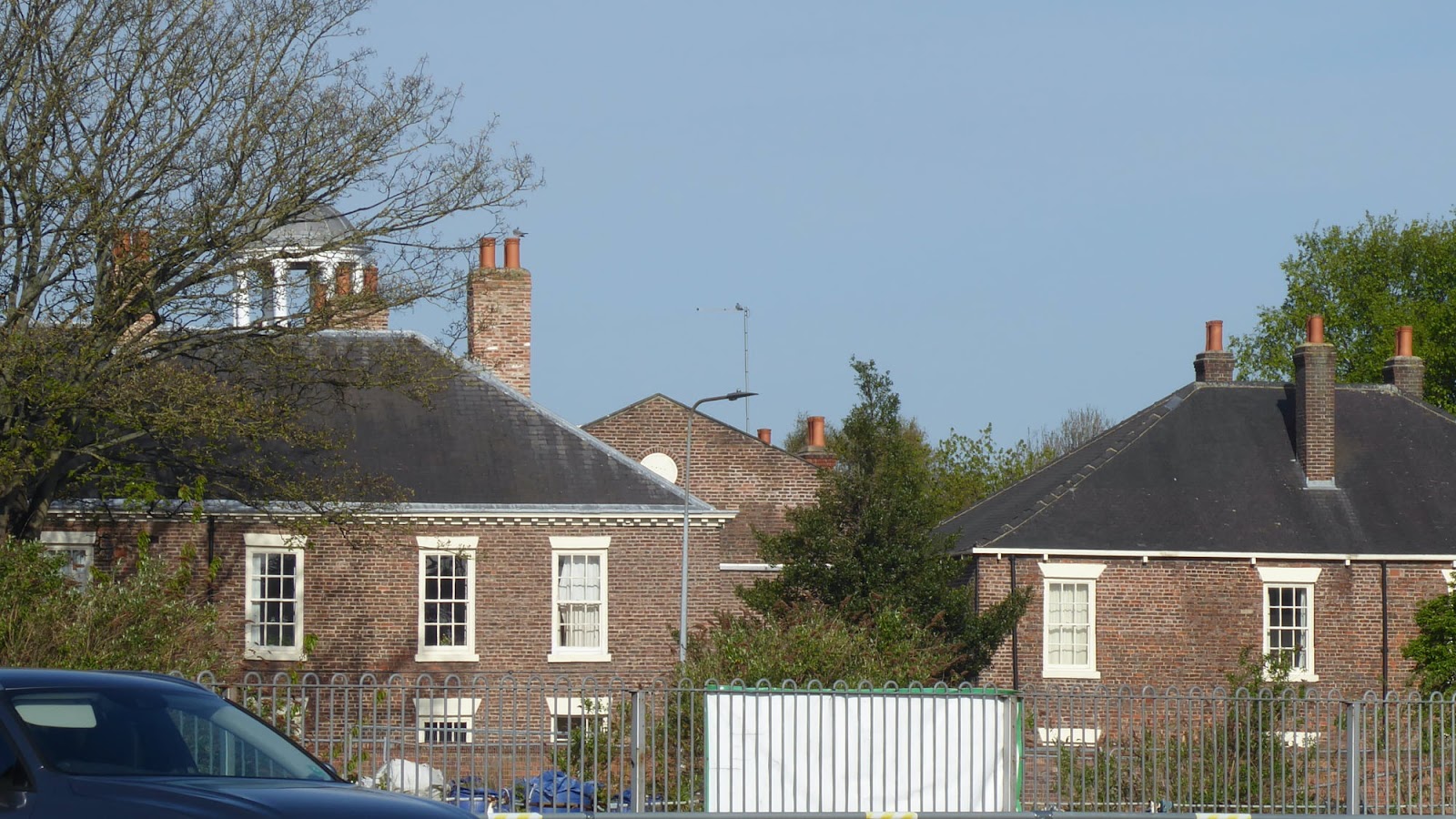
Saturday, 24 December 2022

The puzzle of the Cluderay family

 It is not uncommon to find people following one or both of their parents in becoming residents of the Charterhouse.  Researching one family, however, leaves us with a particular puzzle.

Ruth Ives married James Cluderay in Wortley, Leeds, in 1865.  Their 3rd child George William was born there on 6 August 1871.  By 1879 they were in Hull where their 4th child was born.  James was an engine fitter, and the family had settled at 57 Reform St.  Sadly, James died in 1883.  By 1891 Ruth was head of a household which consisted of herself and her 4 children, her mother-in-law and 2 boarders.  She was working as a machinist and son George was a clerk.  One of the boarders was Sarah M Wilkinson, at 19 the same age as George Cluderay.  5 years later George and Sarah married.

In 1901 Ruth was still living at the Reform St address with 2 of her unmarried children, George (who was described as single) and Arthur.  George was a "labourer in gas house".  In June 1910 she was admitted to the Charterhouse and died in June 1925.  And still described as "single", in 1911 George was living alone at 2 Charlotte Terrace, Waterloo St.  He was working for the railway company as a goods porter.  We lose track of him after that until the 1939 electoral register, when he is in the Charterhouse - with Sarah.  We don't know when they were admitted.  George died in 1944.

The puzzle, obviously, surrounds the marriage and apparent separation of George and Sarah.  Sarah is on the 1901 census as Sarah M Cluderay and married but living with the Branton family and described as their daughter.  With her is her baby son Fred M.  Fred then disappears from the records but Sarah is still living with the Branton family in 1911.

So what was going on in the Cluderay marriage?  Married in 1896, were they together, if only temporarily, in 1900, or was the baby not George's?  They were living apart at least as late as 1911.  When did they get together again?  Sarah lived to be 101, dying in 1972.  

Back to Ruth and James and their youngest child, Arthur, born in 1879.  In 1903 he married Maria Halley and by 1911 they were living at 6 Spring Grove, Hull.  No further record of them is available until the 1939 electoral register, when they were living at 12 Park Rd.  At some point after 1948, when the Charterhouse re-opened (we don't have a date) both were admitted to the Charterhouse.  Arthur died in 1953, Maria in 1961.

Two generations ending their days in the Charterhouse is not uncommon.  But a mother followed by 2 of her children seems to be unique.


Wednesday, 14 December 2022

Picturing the 1780 Charterhouse

 The first pictures we have of the 1789 Charterhouse building are, of course, not photographs but drawings.  

This one seems to commemorate the opening of the new building.
This one appears in Tickell's book on the history of Hull and is dated 1793.  On the western edge is the archway which was the last remaining bit of the priory, and through it can be seen a windmill.  There is no paved road outside the building and no obvious boundary to the property.  The angle from which the drawing has been made is slightly different from what one could achieve today; there are buildings in the way now.


There are very few depictions of the buildings other than the original 1780 structure, including the blocks built behind it.  

This one by F S Smith is the only one which survives, drawn in 1885.  Even when photography was common very few people ventured round the back, so this is a particularly valuable image.


The oldest photo we've found of the Charterhouse is a postcard dated 1904.  This one looks very much like it so is of a similar date.  I wonder if the residents are lined up outside waiting for a funeral procession to go by.  The fascination of this photo is in the external appearance of the building.  It is covered in ivy (or is it virginia creeper?); we know that this didn't survive intact into WW2.  A photo taken in 1941 after an air raid caused blast damage shows most of it has gone from the front wall.  However, the flag pole is still there in the later photo.  Most obviously, the early photo shows the boundary wall and railings.  We don't have the date for when these were installed.


 When the building we now know as Old House was rescued from near-dereliction after the war the brick-work was stripped of all plant life, and the trees were removed.  From then on the photos of the Charterhouse mostly look very similar.  This is one I took about 10 years - but it's out of date.  The very tall chimneys have since been shortened to reduce the risk of them succumbing to high winds.  
People who live and work around the Charterhouse have access to other angles from which to take photographs.  Here are a few.


Occasionally photographers have tried manipulating their pictures to produce something out of the ordinary.
I'm not sure how this curved image was done.


And this one owes much to Photoshop.

There are many ways of looking at the Charterhouse.
[Thanks to, among others, Carol Osgerby, Adam Randall, Ken Hines and UniqueImagesof Hull.]


Friday, 25 November 2022

Just ordinary people

 Most of the people who ended their days in the Charterhouse will remain unknown or be just names on a list.  Public records may tell us the bare facts, but even then the most common names offer no clues to enable us to pin down those facts.  Online searches sometimes reveal more.  Ordinary people had extraordinary things happen to them.  I have tended in this blog to pick those people out simply because they are interesting.  But those who left no traces, the unremarkable lives, would be just as interesting if we knew more.  Here are some of them.

William and Maria Abba (who come first alphabetically in our database) celebrated their golden wedding anniversary in the Charterhouse in October 1902.  

This snippet in the Hull Daily Mail was the only time they got their names in the papers.  William was born in Scarborough in 1823 but soon came to Hull to pursue a career as a shipwright.  He married Maria Bradley in 1847 and by 1861 the couple were living in Grimsby Lane with their 3 children.  Their last child, Gertrude, was born in 1865.  Like many families they moved house quite often.  By 1871 they were on Holderness Rd and William had taken on an additional job as a "fancy goods dealer".  It's possible that this was not a side-line for him but a job for Maria, an attempt to bring in some money in lean spells for William's work as a shipwright. 
By 1881 they had moved to Grotto Square off Mason St and were to remain there until they were admitted to the Charterhouse early in 1897.  They died within a year of each other, Maria in 1904 and William in 1905.

Just ordinary lives, perhaps.  But who knows what dramas, what joys and tragedies, are hidden behind those bare facts.


John Cana was another ordinary man,  He was born in Woodbridge, Suffolk, in 1834.  By the age of 17 he had moved to Staines and was working as a printer's apprentice and living with the printer's family.  He was to follow the printing trade for the rest of his life.  In 1857 he married Betsey Stropher back in Suffolk, and then the couple moved to London, co-incidentally living in Charterhouse Lane there.  He was described on the 1861 census as a printer compositor.  Soon after that the couple came to Hull.  But John's printing business ran into trouble and he went bankrupt in 1869.  It was a common experience for self-employed and small businessmen.  The couple can't be found on the 1871 census but they were in Hull when Betsey died in 1872.  John wasted no time in marrying again, to Elinor Banks who was 20 years his junior.  By 1881 the family were living in Neptune St and John was working as a printer's overseer.  It was safer to work for someone else than to set up on your own.  In 1891 they were still there, with 5 daughters with the surname Banks (Elinor's children by a previous marriage, presumably) and Ada Banks who is "sister-in-law" to John.  It's obviously complicated!  By 1901 they were living in St James St.  (pictured)

John stayed in the printing work as long as he could and. at the age of 72, he was admitted to the Charterhouse in May 1906.  Elinor did not accompany him.  She would have been too young for admission.  But it's possible that the couple had separated before then.  John Cana was a Charterhouse resident for ten years before his death.  Just another ordinary life?


The only claim to fame of William Henry Pepper was that at the age of 18 he was in trouble with the law.  He'd found a way of cheating the blind newspaper on Whitefriargate bridge, and did it several times before he was caught.  He handed over what he said was a sixpenny piece for a penny paper, and the vendor gave him 5d change.  Only later did the vendor discover that Pepper had given him a worthless token of the right size instead of a coin.  So in 1881 Pepper, described as a cloth dealer's labourer, was sentenced to 3 months in Hedon Rd jail followed by 12 months of police supervision - the precursor to probation.  He went straight after that (or was never again caught).  In 1889 he married Annie Manchester and 2 years later he was a Master Grocer at 15 Florence Ave, Queen St.  By 1911 he was a hotel porter, the grocery business presumably not having worked out.  We next pick them up on the 1939 electoral register in the Charterhouse, so the years in between are a blank.  Annie died in 1946 but I don't know when William died.  An ordinary couple with a bit of youthful law-breaking.

Joseph Acum spent much of his life as a grocer and tea dealer in Hull; but he was born and grew up in Sleaford, where he married Susannah Clay in 1821.  By 1851 they were living in New George Street, close by the Charterhouse.  Two years later Joseph was giving evidence to an enquiry into election bribery when Henry Clay had won the Hull seat.  
Joseph said he had been promised 15s. for voting for Clay, and when the money didn't materialise he pointed out that he had done a lot of work for the election.  He never received the money.  (Joseph wasn't the only Charterhouse resident to give evidence to the enquiry.)

In 1861 the couple were still in New George Street (picture below)
But then there is a puzzle.  Joseph was admitted to the Charterhouse in July 1867, without Susannah.  He was 71.  He's here in 1871.  Susannah is living in Spencer St with her daughter and family.  She gives her status as married and her occupation as "agent's wife".  In 1881 we find Joseph in Spencer St with Susannah, as head of the family, though there is no break in his recorded residence at the Charterhouse.  Susannah died 2 months after the census.  Perhaps Joseph had returned to her temporarily  because she was very ill.  He died himself in February 1885, aged 89.  What we can discover about Joseph Acum's life leaves a lot of questions.
There is clearly no such thing as an ordinary person.


Sunday, 11 September 2022

John, Mary, William, Ann

 There are just shy of 1,600 names on my database of Charterhouse residents through the centuries.  Inevitably the bulk of them are from the 19th and 20th centuries, but there are many from earlier (and a few from later).  It was obvious that some Christian names cropped up far more than others, so I analysed the data.  The results were interesting.

I am not a statistician, and I acknowledge the limitations of this exercise.  For instance, lots of people have two Christian names, and I have used only the first of these.  Nonetheless, what emerges is sometimes surprising.

Many names crop up only once or twice.  It's clear that the people of Hull had no truck with celebrity culture.  There is not a single Victoria on the list, and only 5 Alberts.  Horatio Nelson didn't inspire any parents of our residents, and Florence Nightingale only 3.  Some people were given a name which is clearly a surname; it was common practice to use the maiden name of the mother or earlier ancestor as a Christian name for a child, and this probably accounts for the Morrison, Bellamy and 3 Smiths on our list.  The more exotic names, like Theophilus and Zadie May, may be the result of their parents' determination to be different.  Around the end of the 19th century fashions in baby names began to change, too late for many to appear on our list.  For instance, among the women there are none of the flower names which would become so popular.  As for the men, changes include the emergence of Stanley (4), Raymond (3) and Leslie (3).

Here are the top men's names.


This is not really surprising, even if it shows a lack of imagination in large numbers of parents.  John and William together make up 53% of the total in the top ten male names.  In 1903 the local paper commented on the fact that on the latest waiting list of 114 applicants for a room, 3 were called John Brown.
There's a similar pattern in the female list, but with some complications:

In addition to the 95 Marys there are 26 Mary Anns (which make the top ten in their own right) and 13 Mary Janes.  It was difficult to know whether to lump Ann, Anne and Annie together; but many an Annie had originally been baptised as Ann.  There is even less imagination here in the naming of girls than of boys, and the top 4 names make up 72% of the total in the top ten.
We can't extrapolate from this very limited data to the population as a whole.  Our residents generally came from the poorer class of society.  And perhaps Hull people named their children differently to other areas of the country.  It's interesting, nonetheless.


Tuesday, 26 July 2022

Edward Southwick - the Zoo Keeper

 The most exotic occupation of a future Charterhouse resident must be that of Edward Southwick who was a zoo keeper.

The zoo in Hull began as an addition to the Botanic Gardens which had opened in 1812 on the corner of Spring Bank.  By the 1830s zoos were becoming popular around the country, and in 1839 the decision was made to open one in Hull, next to the Botanic Gardens.  It opened in October 1840 and the whole site became known as the Zoological Gardens.  It housed an extraordinary variety of animals, but they were kept in conditions which would outrage us today, and caused concern even then.  

The Superintendent of the Zoological Gardens was John Simpson Seaman, who got the job in 1842.  When Southwick joined is unknown; the 1841 census has been lost.  But he was certainly there as keeper in 1851.  Edward was born c.1792 in Preston near Hedon, Yorkshire; his mother was Dianah and his father was John Southwick. He was baptised on 30th January 1793 and married Ann (nee Mitchel) at Skirlaugh, Yorkshire, on 28th July 1819. Together they had two children: Jane (born 1819 at Preston); and Harriet (born c.1829 at Long Riston, Yorkshire).  What Edward did for a living until joining the Zoo we don't know, but he may have worked at another zoo.  In 1852 there was a second keeper, Robert Wells, who appeared on an advertisement with Southwick but is not heard of again.  The advert was for a "Grand Gala" for the benefit of the two keepers.  
We can see the keeper's house at the top of this map of the Gardens, just above the menagerie.  For 20 years Edward and his family had a home to go with a job which must have been full of excitement.  The Gardens staged fireworks displays, which must have disturbed the animals, as well as galas. equestrian displays and even a balloon ascent.  


But despite their initial success, and continuing popularity, the Zoological Gardens cost huge amounts to run and fell deeper and deeper into debt.  By 1860 it was clear that the problems were intractable and closure was inevitable.  The last ever gala was held on 2 September 1861,  Southwick, who was still there on the census earlier in the year, was now out of a job - and without a home.  We can't pick him up until the 1871 census, when he was living at 5 Mason Terrace with his wife.  He is described as a labourer, although he was 78 years old.  He was admitted to the Charterhouse in June 1873.  Our register does not list his wife so we don't know whether she came in with him.  Edward Southwick died in November 1878.


A huge amount of information about the Gardens can be found in a booklet published by the Hull History Centre, and online at booklet


Monday, 17 January 2022

Song of the Men of Hull

 The Victorians loved a good ceremony.  All sorts of events provided an excuse; visiting royalty, the opening of a new housing scheme, even the start of work on an infrastructure project could occasion a civic party with a band and a choir processing from the station or church or town hall.  So when the Hull Barnsley & West Riding Junction Railway and Dock Company, founded in 1880, cut the first sod to begin a new line between the two towns on 15 July 1881 there had to be an appropriate ceremony.  (It was 4 years before the railway was actually opened and didn't make it quite to Barnsley).

Step forward Henry Kemp, Master of the Charterhouse.  He wrote a poem, Song of the Men of Hull, in 8 stanzas, which was set to music by William Spark.

The medallion of Kemp on the front of the sheet music was, we are told, "executed by Mr Charles Mason, Hull, and presented by him to the Rev H W Kemp B.A."  Kemp was not known as a poet - not surprisingly.  But he did his best to get as much of Hull's history into the work as possible, including Michael de la Pole.  Unfortunately this meant that both the sheet music and the catalogue entry (below) had to go to great lengths to explain that history.  True to the title, it is all about great men.  No women were apparently involved.

I know of only two surviving copies of the song, but perhaps there are more languishing in piano stools or choir cupboards.


The music was the work of William Spark, a Leeds-based organist, composer and music teacher.  How the collaboration came about is not known.  As we see in the lengthy introduction, it starts off in 6:8 time.  Two choirs are then involved, a 3-part and a 4-part.  Perhaps these were intended to be the junior and senior members of a large church choir.  Each verse switches from 3-part to 4-part half way through, and switches rhythm from 6:8 to 2:4 as it does so.  

The event was reported by the Eastern Morning News in mind-numbing detail for those accustomed to watching such occasions on film.  There are two broadsheet pages of very small print unrelieved by pictures.  The full history of the railway company and its plans; the vast numbers of people taking part in the procession representing all aspects of the city's life; who conducted the ceremonies and how; all are described meticulously including the fact that there was a great deal of snowfall.  But one has to plough through to the last column of the first page to find the only mention of the song:  'The "Song of the Men of Hull" was then sung and the vast concourse dispersed"'.  That's it.  Who sang it, who wrote it, the article writer seems not to care.  It would seem that the song was not written especially for the occasion.  And to be fair, it is only the catalogue entry (above) which claims that it was.  The sheet music simply says it was sung then.  Maybe it was the fact that it was sung then which prompted Kemp to get Gough & Davy, Hull's long-lived music shop, to publish it (at the price of 3 shillings - about £10 in today's values, so hardly cheap).  But it was destined to sink into deserved obscurity.

Thanks to Steve Bramley and Andrae Sutherland for their considerable help with the research for this post.


Friday, 7 January 2022

Celebrations

On 5 January 1950, reported the Hull Daily Mail, the Charterhouse held its first ever Christmas party.

The writer is careful; "as far as can be ascertained from records".  But it was probably true.  Early records are patchy and say very little about the residents.  In the earliest phase of the hospital there was plenty of outdoor space for partying, but little, if any, communal space indoors apart from the chapel.  However, it is unlikely that any money would have been forthcoming for celebration meals or the like.  Little changed with the rebuilding of the later 17th century.  
Religious celebrations would have followed the pattern of those in the parish churches.  Before the Reformation, Christmas and Easter could have been exuberant affairs.  Much changed after the religious upheavals after that.  It is said that Cromwell abolished Christmas.  He didn't.  Nor did the Puritans abolish it, or not quite.  What they tried to abolish was the celebration of Christmas; it should be a time of fasting.  When John Shaw became Master of the newly-rebuilt Charterhouse in 1651 we can be sure that there were no unseemly celebrations of any kind.  Shaw was such an ardent Puritan that he was sacked from his job at Holy Trinity and eventually forced out of the Charterhouse.
Another complete rebuild in 1780 again failed to provide a meeting place for residents.  There was (and is) a very large garden behind the Master's house, but it was private and residents could use it only at the invitation of the Master.  
Not all celebrations need to be parties.  Often a gift will do.  The first celebratory gift to the residents that we know about was on 5 November 1608, in commemoration of the foiling of the Gunpowder Plot 3 years earlier.  This may well not have been a one-off, but it is the only time we know about.  Royal occasions were especially popular.  On 3 December 1841 inmates got 2s. each to celebrate the birth of Prince Albert Edward nearly a month earlier.  On 29 January 1858 the Hull Packet reported that the Mayor had “provided an excellent tea for the aged occupants of the Charterhouse” to celebrate the wedding of the Princess Royal to the Crown Prince of Prussia on 25th January. They also got two shillings each (c.£6 today).  Since there was nowhere to hold such a tea in the Charterhouse it is possible that it was at the Town Hall, a temporary HQ for the Council in what had been the Mayor's own house).  And on 10 March 1863 inmates were each given 2/6 (around £10.50 in today's values) to celebrate the marriage of Prince of Wales and Princess Alexandra.  Again, there may well have been other such occasions which were not recorded.  
There was something special about Christmas 1899.  On 21 December the Hull Daily Mail reported a generous gift from the Sheriff of Hull, amounting to about £780 in today's values.  Where this entertainment was held we don't know.  It's possible that a local church hall was hired.  

The next day the paper reported a more practical gift from the local MP (and there wasn't an election in the offing).  At the time a pound of tea cost about 1/7d, around £6.20 in today's values.
For more personal celebrations, particularly from the mid-19th century, there were always the local pubs.  The Charterhouse was surrounded by pubs; but they were patronised by men much more than by women.
The need for a hall of some kind at the Charterhouse had long been obvious, and was discussed from the early 1930s.  The surveyor, John Watson, had a definite site in mind, a patch of land at the western side of the complex facing the road.  But there was never any money.  Finally, late in 1938, the building of a "recreation room" was agreed and work began.  What was immediately known as the hall was completed in August 1939.  The timing was bad.  The RAF expressed an interest in commandeering it, but didn't go through with this. 

Inside, the hall very much resembles a school hall.  It has plenty of space in which chairs and tables can be set out; a stage with rooms behind it; and, essentially, a small kitchen.  But it was ten years before it could be used.  In 1941 the Charterhouse was evacuated and the buildings fell into disrepair,  It was re-opened after restoration in 1948.  In April 1949 the Chairman of the Trustees “gave a tea to the inmates ..... to commemorate the restoration and re-opening of the Charterhouse” - presumably in the hall, which was given the title of the Watson Hall after the surveyor who had done so much to bring it about.  
Celebrations have changed over the years.  It has been a while since residents put on their own shows, for instance.  But we know that the hall has been the scene of memorable occasions.  In 1977 there was evidently a meal to celebrate the Silver Jubilee of HM the Queen.
This photo is from the Hull Daily Mail.  


Recent social occasions have been rather muted affairs, with Covid 19 much on our minds.  Royal births and marriages no longer attract monetary gifts.  There is room for personal celebrations to be held in our own flats.  But maybe we can have a big "do" on the 73rd anniversary of that first Christmas party.

UPDATE June 2022
Since the end of Covid precautions the hall has been busy.  The latest celebration was to mark the Platinum Jubilee, 45 years after that 1977 photo.
It was a less decorous affair.  Times change.


Saturday, 30 October 2021

John Walkington - another piece of Hull's history

 Every older Hull native remembers the Humber ferries and the pier; and most of us have explained that the railway station by the pier never had trains.  Many have enjoyed the hospitality of the Minerva Hotel.  I was interested to discover that a past resident of the Charterhouse was a part of that history.

John Walkington was born in Malton, Yorkshire, in 1786.  He married Sarah Skelton there in 1811.  He was making his living as a currier, the branch of the leather trade which took the tanned leather and treated it for use.  But he and his partner went bankrupt in 1814.  So John seems to have come to Hull soon after and tried a different career,  He disappears from the public record until September 1840,

when an advertisement appeared in the Hull Advertiser.  John Walkington is running what we might now call a boutique hotel at 7, Nelson St, down by the "new" pier, and has apparently been doing so for more than 20 years.  It is ideally placed for the Hull & Selby railway terminus on Railway St, as well as for steam packets crossing the Humber.  Very similar adverts appeared in 1841 and 1843.  The 1841 census confirms John's address at 7, Nelson St but, since that census rarely records occupations, he is described only as "Ind." - of independent means.


This later map (around 1892) shows how well-positioned Walkington's guest house was.


This photo (undated) shows Nelson St with the early Minerva hotel on the left.


In 1848 Sarah Walkington died.  Perhaps it was this which prompted John to sell up - or perhaps the owners of the building knew what was coming and wanted him out.  Certainly John's son, also John, was not in a position to take it over.  He opened another guest house elsewhere in 1849.
And in 1849 John auctioned off the entire contents of the establishment, and the notice of the auction gives us a fascinating insight into the furnishings of a mid-19th century hotel.  It doesn't seem to have made John rich.  Or perhaps the proceeds went to his son to enable him to start his own venture.  Whatever the reason, John Walkington was admitted to the Charterhouse a year later, on 1 August 1850.
The Manchester, Sheffield and Lincolnshire Railway had begun a new ferry service; and their first offices in Hull were opened in 1853 at 7, Nelson St, Walkington's premises.  The building also accommodated a flat for the clerk in charge.

When the 1851 census was taken of Charterhouse residents John gave his former occupation as "currier"; and he did so again in 1861.  Was that old job more important to him than the two decades as a hotel manager?  He died on 29 November 1865.


Thanks to Bill Longbone and members of the Hull: The Good Old Days Facebook group for their help with this research.


Tuesday, 5 October 2021

The powers and duties of the Master

  "... thirteen poor men and thirteen poor women, of whom one should preside over the others and be named the Master... "  So says the license in mortmain granted by the King to Michael de la Pole in 1383.  The foundation deed of the following year goes into a lot more detail.  The Master had to be a priest over the age of 30.  He would have his own house and be responsible for the management of the hospital, the brethren and sisters (including paying their allowances), and the administration of the estates.  He also had to lead daily prayers and say mass two or three times a week.  He would be answerable to the representatives of the de la Pole family, to the Prior of the neighbouring Carthusian priory and to the Mayor of the town.

Little changed until 1525 when the last of the de la Poles, Edmund Duke of Suffolk, died.  Fourteen years later another layer of oversight was removed when the priory was "dissolved" under Henry VIII.  In 1552 King Edward gave the patronage of the hospital to the Corporation of the town.  That consolidated the power of the Mayor and the "Bench" of Aldermen.  But they showed little interest at first, and that meant the Master was left to his own devices.  The temptation was obvious; run down the number of inmates, do as little maintenance as possible, collect all the rents and pocket the surplus money. In 1558 Thomas Turner was appointed Master, and also had to assist at Holy Trinity Church, saying mass at least once a week. This dual role was to become the norm for centuries, but for the first time we see the view that the Mastership of the hospital was not a full-time job.

In 1571 the Bench at last showed an interest in what was happening. They came up with a long list of corrupt practices and petitioned the Archbishop of York to act against Turner. Turner pointed out that the Mayor and Aldermen had the power to deal with him themselves; so they did. The Master was made to swear adherence to a long list of rules, mainly financial (including an annual audit of the accounts), which would put the hospital back on track. In the process the Bench assumed powers it did not legitimately possess. But the next Master, Griffith Briskin, failed to comply and had to resign, owing £50 to the hospital. The problem of how to get rid of a Master was to recur for many years. The Bench could sack him; but what happened when he would not leave? In 1644 they thought that William Stiles had resigned and appointed a replacement. Stiles insisted he was going nowhere. There was a long legal wrangle and Stiles stayed put. It was Cromwell’s Council of State which solved the problem in 1651 by removing him for his politics, and at last John Shaw, who had been waiting impatiently for 7 years, replaced him. That didn’t end well either. Shaw was an extreme Puritan who was eventually sacked by Holy Trinity but refused to leave the hospital. He used it as his base for preaching his inflammatory sermons to his large following before agreeing to move elsewhere.

One power which seems to have been taken out of the hands of the Master for good in the 18th century was that of deciding who was to be admitted to the hospital. The Master received the applications but the Corporation selected the “winners”. This lead to a suspiciously high number of inmates who had connections to the Corporation. A practice grew up of the Aldermen taking it in turn to nominate someone to fill a vacancy, and, unsurprisingly, they rewarded people they knew personally. It was a scandal which was no secret but was only publicised in the 1830s. The newly-constituted Corporation acted to make the process more transparent. In 1847 a committee of Advisers to the Charterhouse was formed – a kind of sub-committee of Aldermen – to deal with admissions and other matters, such as the maintenance of the buildings.

One power, or responsibility, which seems to have been left with the Master for longer was that of collecting rents and organising leases on the lands which gave the Charterhouse its income. By the 1860s the Advisers thought they had control, but John Healey Bromby was not one to leave matters to others. He proposed that, in order to pay for new rooms, part of the land at Hessle be developed as “villa residences”, leased out at £20 per acre per annum. Bromby already had the lessees signed up and the plans drawn. The Committee members were not best pleased at his presumption but were obliged to go ahead. They would not allow this to happen in the future.

By this stage the City Council was becoming determined to diminish the powers of the Master drastically. The role, they argued, was not a full-time job. The Master should become a part-time chaplain, on half his current salary, and he should find and pay for his own lodgings. The matron (a role created in the early 19th century) would run the place on a day-to-day basis. But the Council did not now have the final word. That lay with the recently formed Charity Commissioners, and they refused to countenance the plan. In 1872 they produced a set of rules based on the foundation document. The Council tried to ignore this and go ahead with their own plan but they lost the battle. In 1901 the Charity Commission’s scheme was imposed. There were to be 9 trustees, 5 of them to be nominated by the Council. The duties of the trustees were spelled out, as were those of the Master. He had to take services on Sundays and three other days; visit inmates and enforce discipline among them and the staff; pay the inmates their allowances; arrange for the special needs of infirm inmates and the removal of the insane; and “to appoint and remove the doctor, matron, nurse and porter of the Hospital”. There were few actual powers there, and one wonders whether he could, in reality, appoint staff without the approval of the trustees.

In the wake of World War 2 the question of downgrading the Master's role re-emerged. His house had been badly damaged by a bomb in 1941 and fell into ruin. The hospital itself was closed, and the Master, Arthur Kent Chignell, lived in temporary accommodation and had little to do. The Charterhouse was reopened in 1948 but the Master's House was a bone of contention for several years after. Some people reverted to the idea of the Master as chaplain, with the House being demolished or rebuilt as rooms for inmates. Chignell was naturally alarmed. He wanted a pay rise, not a cut. He asked for an assistant because he couldn’t afford to retire (there was no pension) but was too old to do the work. The Charity Commission was adamant; no assistant. In a letter which is startlingly blunt in its language it insisted that there was no provision or money for an assistant and if the Master was too old for the job he should retire. It seems that an assistant was appointed. Chignell died in 1951 and his assistant, Ronald Helm, succeeded to the Master’s job. In 1956 the House, rebuilt as closely as possible to the original, was reopened.

What few powers remained to the Master were weakened by the holder of the post of Clerk to the Trustees. He was also the Town Clerk, and he tightened the grip of the Council on the Charterhouse. One long-serving clerk took to pre-empting or ignoring any decisions by the trustees. At one stage he told the Master of the time that he should not be handling money. The Master responded that he couldn’t not handle money and he pleaded for a written job description. It is not clear if he got one. (The clerk to the Trustees is no longer a Council officer.)

The scheme of governance has been updated several times in the last 120 years, but the clauses on the duties of the Master remain almost the same, except that he (or she) no longer appoints staff without reference to the trustees and, of course, no longer pays allowances to residents. The emphasis is on duties rather than powers. No doubt the situation will continue to evolve, but the position of Master of the Charterhouse survives after 637 years.


Tuesday, 21 September 2021

The life and death of Robert Brock

 I wrote about Robert Brock's death in an earlier post.  He was the first person in our database of Charterhouse residents whose death was worth investigating.  Now I have researched more about his life; and it's a fascinating story.

Robert was born in Stainforth near Doncaster in 1813 and baptised in nearby Hatfield.  His parents were George and Elizabeth.  Stainforth was (and still is) a canal town, on the Stainforth and Keadby Canal which connects the River Don Navigation at Bramwith to the River Trent at Keadby, by way of Stainforth, Thorne and Ealand, near Crowle.  The waterways in this part of the country are part of a system which dates back to Roman times, connecting the Humber Estuary with the rivers to the west and south.  For centuries sailing vessels called Humber keels plied these waters, and the Brocks may well have come from generations of keelmen.  Whole families spent their lives on board, transporting goods to and from the Humber ports to the towns of Lincolnshire and South Yorkshire.  Many birth certificates showed the place of birth as "on water".  

Stainforth

On 30 October 1839 Robert Brock married Mary Richardson in Hull.  Mary came from Beverley.  In August 1840 Robert's name appears briefly in  the Hull Packet when two boys were charged with stealing a rope from his boat.  Evidently the Brocks were based in Hull from now on.  They are not to be found on the 1841 census but their son George Thomas was born in that year.   The 1851 census misses them, but Robert's older brother Thomas is there, with his family at 100 High St, Hull, and describing himself as a shipowner.  Perhaps he owned a keel which was crewed by someone else.
Robert and his family were moored in Hull's Old Harbour on census day 1861.
The "keel of river trade" called the Carrier had Robert as its Master, son George as mate and Mary as Master's wife.
Four months later Robert got his name in the papers again.  On 3 August the Hull Advertiser and Exchange Gazette reported:  


The incident didn't put Robert off a life on the canals.  Such mishaps were not unusual.  In 1871 he was on the Stainforth canal with Mary and a 14-year-old boy as "servant".  But Robert was perhaps finding the work increasingly hard as he got older.  By 1881 he and Mary had settled at 20, High St, Hull.  Robert described himself as a general labourer.  He was 68 and probably just picking up whatever work he could find.
On 3 May 1887 Robert and Mary Brock were admitted to the Charterhouse.  Five years later Mary died.  
Our register records that Robert Brock, aged 81, died on 7 January 1895.  But a note adds: "Presumably; body having been found in the Queen's Dock".  This prompted me to send for his death certificate, and I then found a letter in the archives.  Together they tell us more of the sad story.  7 January was the date he went missing from the Charterhouse.  Presumably there was a search; if there was, it was unsuccessful.  On 26 January, and again on 30 January, it seems that the Master assumed he was dead and was writing to the the council's Charterhouse Applicants Committee asking them to fill Brock's vacant room.  A letter survives from the Town Clerk in reply on 31 January saying that they were deferring a decision "in the hope that some news may be heard of Brock".  His body was not found for more than two months; it was recovered from the dock on 15 March.  There was an inquest, and the verdict was that he had drowned.  It leaves so many questions unanswered.  How did he come to fall in the dock?  Why did the body not surface for two months?
Can one say that it was an appropriate death for someone who had spent so much of his life on the water?


Saturday, 4 September 2021

Thomas and Mary Ann Giles

 Like many Charterhouse residents, Thomas Giles was not born in Hull.  He was baptised in Camblesforth near Drax on 28 May 1820.  His father died when he was 9 and his mother remarried; by 1841 the family were living in Drax, where Thomas was described as a journeyman joiner.  That same year Thomas married his first wife, Anne Dean, on 27 Sept in Holy Trinity, Hull.  He was to spend the rest of his life in the city.  At around this time he started a business of "joiners, carpenters and builders" called Giles & Brown with a partner called James Brown.  The partnership didn't last long.  It was dissolved on 16 February 1855, and Thomas took on all its debts and assets.  In his hands the business prospered.  

Perhaps because of his experience, Thomas Giles got involved with the Hull Guardian Society.  These societies were taking over from the earlier Trade Protection Societies which were formed by local business owners to deal with creditors who failed to pay their debts.  We have seen many times in the stories of Charterhouse residents who had been in and out of bankruptcy that businesses failed with great regularity.  An auction of stock and assets would be arranged to pay off the debts, and the business owner might be imprisoned for a while until he could raise enough money.  Not long after, he would start up the business again.  Some of this was due to a banking system that wasn't geared to overdrafts and loans for a business with temporary problems.  Some of it was down to bad debts and not being able to afford to pursue the debtor through the courts.  The Guardian Societies enabled business people to club together to pursue the debts and perhaps to blacklist persistent bad payers.  On 28 Feb 1857 Thomas was nominated and elected along with many others to be a member of the Hull Guardian Society – to protect trade in the city. The event was held at George’s Inn, 66 Whitefriargate, with the society based on Trinity House Lane.  

Thomas Giles' wife Anne died in October 1859, leaving him with 6 children.  A little over 7 months later he married Mary Ann Gibson at All Saints, Sculcoates.  The family lived at 11 Grimston St, a building which still exists and is now listed.  (left).  Thomas ran his business from 12 Worship St.  
It wasn't all plain sailing.   In 1862 Thomas appeared at Hull Police Court charged with breaching the Builders Act.  One charge was that he had built a property on Park St with walls only 4.5 inches thick, when the law said they had to be 9".  He was given 14 days to rectify this, with increasing financial penalties after that.  It didn't do him any harm.  In 1873 and 1876  he was the President of the Hull Subscription Mill Society.  This had its origins in co-operatives attempting to bring down the high cost of good quality flour.  The Hull society was founded in 1800 and continued until late in the century.  

Giles was also Honorary Secretary of the Hull Mechanics' Institute, founded in 1825.  These institutes brought education, largely in evening classes, to working men and were a valuable part of the movement towards giving greater opportunities to the working-class and broadening their horizons.  They had their less earnest side; in Thomas Giles' time there were also theatrical performances.
With all this success, and no evidence of bankruptcy, it seems odd that Thomas and Mary Ann should seek to end their days in one room at the Charterhouse.  But they were admitted on 30 October 1884.  Our register is, as so often, confusing.  Mary Ann is not registered until July 1889.  Thomas had died in March 1886.  It was at that point that we would expect a widow either to be evicted (so we would have no trace of her) or to be awarded the room, or another vacant room, in her own right.  The more than 3 year gap seems excessive.  Yet it is unlikely that Mary Ann was evicted in 1886 and given a room 3 years later.

Mary Ann had her own moment of fame to come.  In 1899 she was the subject of a lengthy article in the Hull Daily Mail when the story emerged that she stood to inherit a fortune from a long-lost uncle, William Gibson, who had died many years before in Calcutta.  Years had been spent looking for his heirs, and it seemed that Mary Ann was one of them.  She and four other heirs, one of them Thomas and Mary Ann's son John, stood to inherit over a million pounds.  We hear no more about it; there is no follow-up in the press.  It seems improbable that she and her son actually got any money, and she died 4 years later.  Our register has her date of death, correctly, as 26 April 1903, but the death notice in the paper says she died at 62 Prince's Rd, her son's address.  Perhaps she had been moved there in her last days to be cared for.
Thomas and Mary Ann Giles were in some ways not a typical Charterhouse couple, but they show how diverse and interesting are the people behind the names in the register.

(Thanks to Joanne Bone, a descendant of the Giles, for much of the research into the couple.)


Monday, 9 August 2021

The sculptor and his widow


Everyone in Hull is familiar with the work of William Day Keyworth junior, whether they know it or not.  He was a sculptor who followed in the footsteps of his father and created many works which are landmarks in the city.  

Keyworth was born in Hull in 1843 and spent some of his early years in Chelsea, London, developing his craft.  In 1875 he married Elizabeth Pybus in Hull and they settled at 2, Osborne Villas, Spring Bank.  By 1891 they had moved to a larger house at 244 Spring Bank; William had a workshop / studio at the rear of the house.  There he sculpted statues of Hull's best-known figures, among them Andrew Marvell, William Wilberforce and William de la Pole.  He was patronised by the Wilson shipping line family and his marble busts of members of the family were exhibited at the Royal Academy.  He made a figure of Britannia for the front of the Exchange Buildings in Lowgate; and, branching out of Hull, he made the colossal lions for the front of Leeds Town Hall.  On a much smaller scale, he made the memorial to W T Dibb which was affixed to the wall of the chapel of the Charterhouse in 1888.

It seemed to be a success story.  William and Elizabeth had two daughters and, at least in 1892, two homes, the second at the seaside in Withernsea.  But on Saturday 9 August 1902 William took a service revolver into his workshop and shot himself in the head.  That was the assumption, and it seems the obvious one.  But he left no suicide note, and no one was quite sure why he'd done it.  The burial register says "Suicide - no evidence as to state of mind".  The likeliest reason was money troubles.  The demand for his style of work had diminished, and perhaps he was in debt.  Elizabeth did not attend the funeral on 12 August, but we cannot read too much into that.

Elizabeth Keyworth was living in Hornsea in 1911, at 2 Marine Drive with her two daughters, neither of whom were married.  On 1 August 1914 she was admitted to the Charterhouse  She didn't stay.  She is not on the 1920 electoral register as a resident, or on subsequent ones, but she didn't die until 1929.  Her burial record mentions Hornsea so perhaps she returned to Marine Drive.  

Monday, 12 July 2021

Contrasting lives: Sarah Herdsman and Henry Jollands

 Sarah Herdsman died in the Charterhouse on 14 February 1914 of "senile decay" at the age of 82 and was buried in the Western Cemetery.  There would seem to be little remarkable about her; a single lady who had lived the last 19 years of her life in room 103 of the Charterhouse.  Yet Sarah would have had some interesting stories to tell.

She was born in 1832 in Beverley, the daughter of farm workers.  By 1851 she was a housemaid in the household of Edmund Smith at 11, High St, North Ferriby.  Smith was a retired officer in the Indian civil service and a director of Payne & Smith's bank.  He, his wife, 2 daughters and 8 servants formed a prosperous household.  

High St, North Ferriby

Ten years later Sarah had become a cook in the somewhat more modest household of Thomas Firbank, a JP and retired merchant at 8 Charlotte St, Hull.

It's hugely frustrating that we have only these ten-yearly snapshots from Sarah's life, so we don't know what took her from Hull to London.  All we know is that in 1871 she was the cook in the Mayfair of the small household of the great Florence Nightingale.


Florence, aged 50, is Director Nightingale - and then a scribbled additional word which may be Nurses.  She has a personal maid, a cook (Sarah) and two housemaids.  She had set up the Nightingale Training School At St Thomas's Hospital in 1860.  It is now part of King's College, London.  

How long Sarah worked there we don't know.  She doesn't appear on the 1881 census, and has been replaced as Florence's cook.  We don't catch up with her until 1891 when she was living (or at least staying) "on own means" with her nephew in Scarborough.  When, and why, did she return to Hull, a place where she did not have deep roots?  On 10 January 1895 she was awarded a room in the Charterhouse, so she apparently did not have enough money to maintain a household of her own.  Did she regale her neighbours with tales of her famous former employer?

Henry Jollands led a very different life.  We first find him in the Spilsby workhouse in Lincolnshire, aged 11, in 1861.  (Confusingly, he shared a name and year of birth with another boy in the same county.)  Our Henry was born to a mother, Sophia, described by the workhouse authorities as an "imbecile" i.e. having severe learning difficulties and had been there all his young life.  Sophia then disappeared from the records, to turn up again in 1901 in the Lincoln Union workhouse.  

1881 census
Henry married Ellen Simpson in 1877. He next appears on 19 November 1880 in the Stamford Mercury: “I, Henry Jollands of Boston, will not be answerable for any debts collected by my wife Ellen Jollands after this date 19 November 1880. Henry Jollands.” On census day, 3 April 1881 Henry is in the lock-up on Victoria St, Grimsby, in the custody of Police Superintendent Geoge Jarvis and his wife. Oddly, he is described as “Head prisoner [illegible] one in lock-up”. What he was doing there becomes clear 5 days later in the Lincolnshire Chronicle: Henry Jollands of Clee, brought up on remand, charged with using threats to his wife, was ordered to find sureties, himself in £20, and one in £20, in default one calendar month.” 


Victoria St, Grimsby
Clearly it was not a happy marriage.  Ellen disappears from the record - fortunately for Henry, as it turns out.  By 1888 he was in Hull marrying Caroline Clark, almost 20 years his junior, and he seems to have become a family man, with 8 children eventually.  In 1891 they are living with their children in Peel St, Hull, where Henry is some sort of dealer. Ten years later they are managing a lodging house at 56 Salthouse Lane, and in 1911 he is the caretaker of a Catholic school and living at 5 Blundell St.
Peel Street

We don’t know when the couple entered the Charterhouse, but they are there on the 1926 electoral list. Caroline died in 1933, Henry in 1939.