Thursday, 20 February 2020

Lady Alice and the Hull foundations

How much involvement did the de la Pole family have in the life of the priory and hospital that Michael de la Pole founded?  Records of the early priory and hospital are sparse.  Michael rarely visited Hull in what remained of his turbulent life.  We know that in 1408 the 2nd Earl of Suffolk, Michael's son, granted further extensive lands to the hospital.  But after his death in 1415 at Harfleur, and his son's a month later at Agincourt, it was the 4th Earl, and 1st Duke, William, who inherited the responsibility for the Hull foundations.  Did he take an interest in them?
The Cloisters at Ewelme
William had as turbulent a life as his forebears.  But he married Alice Chaucer (granddaughter of Geoffrey Chaucer) and the couple made their home at Ewelme in Oxfordshire.  In William's frequent absences it was Alice who oversaw the foundation of an almshouse there for 13 poor men, together with a school.  The almshouses survive to this day.  On 2 December 1439 William himself granted the manor of Rimswell in East Yorkshire to his Carthusian priory near Hull.  William was killed in 1450 and his remains delivered to his widow.  Although Bulmer's Gazeteer of Hull in 1892 states that in his will he desired his "wretched body to be buried in the Charter House at Hull", he was in fact buried at the family estates at Wingfield in Suffolk.  His son John was still a minor and it was Alice who took the reins.
A hugely informative book was published in 2001, God's House at Ewelme by John A A Goodall [pub Ashgate Publishing Ltd].  Among the archives that Goodall studied was a single sheet relating to the Hull priory.  It's amazing that it survived at all; it is water damaged and is a draft of an indenture, written in abbreviated Latin and much corrected.  Goodall states that it is very hard to read and translate, but offers the following translation:
To all the Christian faithful to whom this written indenture shall come, Henry, Prior of the Carthusian house of St Michael beside Kingston upon Hull and the convent of the same, greetings in the Lord.  The late William de la Pole gave to the late Prior, John Gannesfeld, and the convent in perpetuity the manor of Rimswell in the County of Yorkshire with its appurtenances on 2 December 1439, by licence of the King.  Out of consideration of the devout and pious intentions between us and the late Duke and the venerable lady and princess, Alice, Duchess of Suffolk, his wife, we grant that one monk of the house shall, every Friday, during the life of the Duchess, read, and say the Seven Penitential Psalms and a Mass with the office Reministere, celebrated specially for the good estate of the Duchess and her son, the prince John, now Duke of Suffolk.  We grant, moreover, that from this time forward we will celebrate in perpetuity the anniversary of the aforesaid Duke and also the Duchess, when she has died.  Beyond this we agree also that in the near future we will have made two stone images, one in the likeness of the Duke and the other in the likeness of the Duchess, the which shall bear on the right hand a disk, in symbol of bread and fish, and on the left hand an ale pot, in sign of a measure.  These images shall stand in an eminent place in the refectory of the said convent for ever.  In the presence of these images, I, the aforesaid Henry, and my successors as priors of this house, or our procurator or our representatives if we are ill or indisposed, shall distribute two messes of drink, fish and bread in perpetuity to a maximum of two almsfolk, according to our discretion.  That is to say to a man and to a woman, two conventual loaves, each weighing one and a half pounds, and two conventual measures of ale containing two quarts each.  Conventual messes according to this form shall be made on Sunday, Tuesday, Thursday and Saturday, except in Lent and on Monday, Wednesday and Friday, when fish shall be provided.  These messes shall now and for ever be the same as those of two monks, except on the days when the Carthusian rule demands abstinence from fish.  On those days the poor shall not be deprived of their messes.  In respect of our distribution of food to the two paupers they are to offer prayers for the souls of the Duke and Duchess, their ancestors, parents and all the faithful departed.  If we fail in the discharge of any of the above duties we will pay £10 to the Duchess and her successors and forfeit the manor of Rimswell and its appurtenances as they have been described.  In testimony of which thing we keep one part of this indenture, sealed by the Duchess, while the other part remains with her, sealed with the conventual seal, given in our chapter on 1 October 1462.
This document contains the only mention of a convent in the records we have; but this was frequently used for an all-male religious establishment.
Alice wanted herself and William to be remembered in statues and in the giving of food and drink to the poor, paid for by the income from the manor of Rimswell in East Yorkshire.
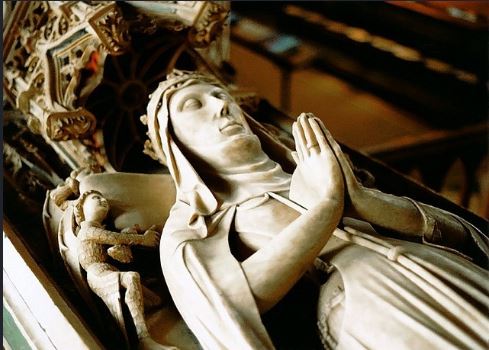
Alice's tomb in Ewelme church
Even more interesting than the information about the priory is what is "scribbled" - Goodall's description - on the back of the sheet.  It's a list of the poor men and women in the "New Hospital", the neighbouring almshouse.  Alice had the right of presentation to this; effectively, she had to give her approval.  Disappointingly, Goodall does not give all the names.  This is part of his transcription:
Names of men are listed with a note of their physical health - "sturdy and powerful" or "young and ill" or "poor and old" - and the name of what appears to be a sponsor.  So "able and powerful" Richard Grawngby was appointed at the "instance" of a certain John Hastmore; two men were appointed "by the will" of the Prior of the Charterhouse, one "by" the late Master Peter of the foundation; and the "powerful" William Malyard at the "instance" of G. Crysto and the present Master.  Two men apparently have no proposers - the "poor and old" John Beanghorn, who heads the list, and John Hadelsey, who ends it.  The women are not individually named - there were eleven, five "debilitated" and six "young and strong".  Beneath is a sentence reading "none of these are tenants of my Lady and one, called Joanna Mayre, was lately received without the licence of my Lady".  A note under this list reads: "memorandum of John Campyon comorante per le North feyre in Hull, faithful tenant of my Lady for 25 years, old and debilitated".
Campyon appears to be someone whose place awaited ratification.
The system appears to be that to get a place in the hospital the applicant needed the support of someone prominent such as the Master or a de la Pole servant.  It helped to be a tenant of de la Pole lands but was not essential.  The Duchess had the last word, signing off the names, but usually after they had been admitted. 
This scrappy document provides a fascinating glimpse of the continuing relationship between the de la Pole family and the foundations of their forebear, the 1st Earl of Suffolk.  And it gives us the names of the earliest inmates to emerge as real people.

Wednesday, 29 January 2020

In the 19th century news

When a name on our 19th century register is uncommon, a trawl of the local papers on the British Newspaper Archive, together with the usual genealogy sites and search engines, can turn up some interesting potted biographies and social history.

Take Cornelius Kingdom.  He was born in Hull in 1851.  He crops up in the Hull papers first in December 1867.  He was apprenticed to the owner of a Hull fishing smack, but absconded and was caught in Grimsby.  He was sentenced to 7 days in prison.  He must have decided that a life at sea was not for him and on the 1871 census he was a fishmonger.  At some point he went back to fishing.  He next turns up in November 1894 as the skipper of the steam trawler Madras.  The boatswain had a bad accident while they were at sea and Kingdom had to return to Hull.  A journal published in 1900 tells us that the Madras was the first Hull trawler to have a the otter trawl fitted, with great success.  But in 1901 the vessel was involved in two collisions with other trawlers, in the Humber in calm conditions, and after the second the Madras foundered without loss of life.  We can't be sure that Kingdom was still the skipper at this point.  His last mention in the news came in 1904 when he was in command of the steam trawler Jed.  It was involved in what became known as the Russian outrage, when the Russian Navy attacked the British trawler fleet by mistake.  Kingdom and his ship apparently were unscathed.  But he left the fishing life and the 1911 census describes him as a general labourer.  In February 1924 he was admitted to the Charterhouse and died two years later.

An earlier resident, Samuel Mozeen, had a very different life.  Born somewhere in Yorkshire in around 1799, he was apprenticed to gunsmith George Wallis Jnr, the son of a famous gun maker who had taken over the business when his father died in 1803.  When Wallis junior died in 1833 Mozeen advertised that he had taken on the business at the same Mytongate premises.  Shortly afterwards he took over from another famous gunsmith, John Blanch Jnr, at 26 Silver St.  Mozeen did not advertise again until late in 1849, when he announced that he had sold all his stock to William Needler of Scale Lane.  A year later he was awarded a room in the Charterhouse; the register says he was 54, though he was probably a couple of years younger.  Either way, he was too young.  He died in July 1850.

Cornwell Baron didn't appear in the papers very often, but when he did it was for the wrong reasons.  Born in 1785 in Ulrome, he went into business as a timber merchant, with a partner, but went bankrupt in 1810 and 1812.  By 1819 he was insolvent again and imprisoned for debt.  In July 1833 a very small item appeared in the Hull Packet: "Cornwell Baron (47) was charged with embezzling certain sums of money, namely £3 5s.4d. and £2 10s."  On the 1851 census he is described as a merchant's clerk, and lived in Providence Row, Walker St.  His wife Elizabeth died in 1853, and Cornwell was admitted to the Charterhouse in July 1854.  He died on 21 Mar 1862, leaving a will but effects of less than £20.

One of quite a few Charterhouse men in the clothing trade was tailor and draper Robert Bellard.  He was born in 1785 in Welton near Hull and christened in Swanland Independent church, so came from non-conformist stock.  His first advertisement appeared in the Hull Packet in April 1819.  His shop is at 14 Bridge St.  He says that he just returned from London with the latest fashions (dubious, but all the tailors and dressmakers said it) and various kinds of cloth the names of which mean nothing now.  In 1821 his ad reported that he had moved to Dock Office Row, and his ads in subsequent years show that is where he stayed.  In 1845 he said that he had taken on a cutter.  There are no more newspaper advertisements, and he was admitted to the Charterhouse in January 1856.  He died in 1858.

Theophilus Routledge was another tailor, but of menswear.  Born in Easington, Co Durham, in 1827, he was in Hull by 1851, staying with his older brother John on Hessle Rd.  Both were tailors, although the census says that Theophilus employed 6 men and John only one.  They appear to have been rivals rather than partners.  The only advertisements that Theophilus placed were all in 1854, when he had premises at 32 Queen St as a "merchant tailor, hatter and gentlemen's outfitter".  The first ad offered an Aberdeen hat (?) for 12/6d.  The other two, both in December, promote a raglan cloak with sleeves, and a reversible overcoat.  Routledge was still described as a tailor in 1871 and 1881, but is in lodgings in East Hull, and had perhaps fallen on hard times.  He was admitted to the Charterhouse in December 1893 but in February 1901 he was "removed for drunkenness" and went to the Willerby Asylum, where he died in June 1901.

Born in 1802, Michael Parker worked for 25 years for the W & J Walker iron works before announcing in the spring of 1849 that he was setting up in business as an ironmonger on his own account at 32 Scale Lane.  A year later he moved to 75 Lowgate ("four doors from the Town-hall" as his ad pointed out).  He seems to have concentrated on bathrooms and showers.  In 1855 he expanded into premises with "commodious and elegant showrooms" at 57 Lowgate and had taken over another local firm.  Perhaps he overreached himself.  January 1857 he was advertising a large variety of goods.  But By 1857, however, he was bankrupt, with his valuable stock being sold at auction.  He climbed out of bankruptcy in 1859 and started up his business again.  But it didn't last.  He was bankrupt again in 1865.  His wife died in the same year.  But he was back in business as a "tinner" by 1871, and a supplier to the Workhouse.  We next hear of him when he was admitted to the Charterhouse in February 1879.  He died in December 1884.


Sunday, 19 January 2020

Remarkable Residents 3: Colley Bedford

He is another resident on our 19th century register whose life shows that having the right connections helped in getting a place in the Charterhouse until well into the 19th century.  Colley Bedford was born in Folkingham, Lincolnshire, in 1789.  He married his first wife, Louisa Kirk, when he was only 17, in Sheffield.  We know nothing about his subsequent work and travels until 1821 when Louisa died in Hull "in the prime of her life" [Stamford Mercury].  By this time Colley was a tailor.
This ad is from the Hull Advertiser of 31 May 1822.  Whether or not he had "just returned from London" is dubious, since he said exactly the same thing in an ad a year later.
In 1825 Bedford remarried, to Sarah East, the daughter of a Lincolnshire farmer.  By the 1830s he had become involved in public life.  In 1833 he was elected Surveyor of the Highways, and also as a church warden for Holy Trinity church.  The latter post was contentious.  James Acland was another man proposed but rejected.  How involved Bedford was with Acland at this stage is not clear, but by 1835 he was on the committee of the Hull Reform Association, Acland's campaigning radical political group.  Another future Charter-house resident, John Jackson, was also involved.  At some point Bedford was elected to the Board of Guardians and on 5 December 1836 he was appointed their auditor.  In 1837 he put forward a motion to eject the man who had been Surgeon to the Guardians for 35 years.  This sparked a move to get him disqualified as a Guardian.
The Board of Guardians were very powerful, administering the Poor Law, overseeing workhouses and other forms of poor relief.  It was meant to be politically neutral but that was clearly impossible.
Bedford also became prominent in Freemasonry, becoming Master of the Minerva Lodge in Hull.  He was also a member of the Brough Hunt, enjoying hare-coursing.
In his business life Colley Bedford had formed a partnership with John Turner Milner, described as a pastry cook, in 1834 or earlier.  In 1840 the partnership was declared bankrupt.  Bedford soon tried to bounce back.  By 1841 he had moved both his business premises and his home to a house on King Street.

By 1845 he was advertising in the local papers again.


(Google does not offer any help with what exactly a "pantelot" was.)  He makes plaintive reference to his four years of  "considerable difficulty" and the "real friends" who continued to support him.  But he could not recover his former prosperity.  In April 1846 his wife Sarah died, "after a long and painful illness, borne with Christian resignation" according to the notice in the local paper.  She was only 46.


The Freemasons stood by him, presenting him in February 1847 with an inscribed arch jewel, a masonic emblem.  But by 1848 Colley Bedford was an insolvent debtor again.  He was discharged in March 1849, but in order to pay off his debts he had had to sell his house and its contents.  There was no way back.
His connections proved valuable.  On 2 October 1851 he was elected to a room in the Charterhouse.  He died on 26 April 1857.

Saturday, 11 January 2020

Remarkable Residents 2: John Merriman

To get a room in the Charterhouse in the 19th century it certainly helped to have the right political connections.  One who did was John Merriman.
He was born in Durham on 17 August 1804.  Nothing is known of his early years, but by 1836 he was in Hull and in partnership with a man whose surname was Hansell*.  Together they set up a business at 13 Silver St as high class drapers.  The Charterhouse owned much of Silver St, but this may well be a coincidence.
Silver St, Hull
Hull Packet, April 1837
It is well worth googling the unfamiliar fabrics, and the accessories are fascinating.  They were clearly aiming at a fairly affluent clientele.  In 1846 John married Hannah and they appear to have lived above the shop.
Ten years later fashions had changed and furs were added to the stock.  This is from April 1847.

But by 1853 they had decided to get out of the drapery business.

It's interesting that the firm to which they sold their stock, Edwin Davis & Co, were still in business in Hull up to the 1960s.
Merriman & Hansell now went into ship-owning and insurance (the two often went together in this period), with offices at 11 Parliament St.  By 1876 Hansell was out of the picture and John had an office at 33 Pemberton St. in East Hull - a distinct step down from Parliament St.  But by then the couple were living at 6 Hornsea Parade, Holderness Rd.
We know of two ships owned by the partnership.  One was the barque Guiding Star, built in Sunderland in 1853 and registered to Merriman & Hansell from 1865 to 1872.  This was abandoned while carrying coal in 1872.  The second was the Kathleen, a German-built barque which was six years old when John acquired it in 1870.  This was detained after an inspection in 1875 in Hull and found to be rotten and unseaworthy.  It was broken up.  It appears that ship-owning had not been a success.
After leaving the drapery business John also entered into civic life.  In 1858 he was elected as a commissioner in the Humber Pilot office.  In 1860 he was a church warden at St Peter's, Drypool.  And in August 1861 he became a City Councillor.

It's interesting that he beat a Reckitt.  By 1866 he was a member of the Board of Health.
By 1881 John and Hannah were living in Argyle Terrace; we are uncertain which of two possible streets this was, but neither suggest that the elderly couple had much money, and they may well have been in poor health.  On 15 January 1885 they were awarded a room in the Charterhouse but died within a month of each other in October and November of the same year.

* This may have been Thomas T Hansell, who was a Hull merchant but this is a guess.

Thursday, 9 January 2020

Remarkable residents 1. Robert Rivers Melbourne

He was admitted to the Charterhouse on 9 November 1868 when he was only 56, a clear breach of the rules.  But Robert Rivers Melbourne was a local celebrity.
There are a number of confusions about dates.  It's not clear, for instance, where he was born; the 1861 census says London.  It's also unclear exactly when he became manager and lessee of the Queen's Theatre on Paragon St, Hull.  Most reports say 1854, but a newspaper story in 1933 tells of his pioneering balloon ascent from the Zoological Gardens in 1849.  However, he was in Belfast in 1848, managing the Theatre Royal there and marrying Caroline Lewis of Bristol.  (She was 27; he was 37).
Melbourne was in partnership with Joseph Henry Wolfenden, and the pair got the licence to run the Hull theatre in 1857 - or perhaps earlier.
Queen's Theatre, Paragon St, Hull
In the same year Melbourne and Wolfenden applied for a licence to run the Theatre Royal in Sheffield.  When there were objections to this, they argued that their licence to run the Queen's in Hull had already been renewed several times because it was all legal and successful.  There is no further record of this application.
Wolfenden died in 1861 after being thrown from his horse.  He was only 34.  Melbourne paid for his grave in the Hull General Cemetery.  Wolfenden's widow, Henrietta, took his place in the partnership with Melbourne.  [Caroline Melbourne now becomes something of a mystery.  On the 1861 census she is a visitor at the home of a family in Sculcoates (Hull).  In 1864 and 1867 the local papers report three occasions on which a Caroline Melbourne is charged with theft, twice of bed-linen, but one would have expected them to mention the fact if this is Robert's wife.  We don't know whether she entered the Charterhouse with Robert, but after his death she would have been evicted and she tried to earn her living as a dressmaker, lodging with various families.  She died in 1885.]
The theatre seems to have been successful if the number of advertisements for shows is any indication.  For much of the 1860s these appear frequently in the local papers, particularly in 1864 and 1865.

This one is from February 1864, advertised for the "benefit" of Henrietta.  It shows a typical theatre programme of the time, a mixture of short plays and music.  Notably, Melbourne himself acted in the "farce" which concluded the evening.


Also from 1864, this one advertises a visiting opera company, including a benefit evening for the leader of the company, Louisa Fyne.


There was also an annual pantomime.  This one ran through January 1865 with special trains advertised to bring people from places like Grimsby and Withernsea.  In 1866 Henrietta Wolfenden died and was buried in the same grave as her husband.
The pantomime staged in January 1867 proved to be the last.  In February Robert filed for bankruptcy, with liabilities of about £1,500 (about £94,000 in today's values).  He had been generous with his money, but the debts suggest that the theatre had been losing money for some time.  His friends rallied round.  There was a benefit performance at the Theatre Royal and, with what we would now call crowd-funding, the debts were paid and the bankruptcy discharged in June 1867.
Robert tried to start again.  In September 1867 he acquired the use of the lecture hall in the old Mechanics' Institute building in George St to set up a music hall.
The venture seems to have failed.
His theatrical friend Mr Coleman helped out again, engaging him to take part in a 7-night performance in the spring of 1868.  But that was the end of Robert's career.  He was  already a sick man when he was given a room in the Charter-house in November 1868.  He died only 2 months later on 15 Jan 1869.


 He was buried in the same grave as Joseph and Henrietta Wolfenden.  The headstone no longer exists.
The Queen's Theatre was closed for good in 1869 and its contents auctioned off.

Thursday, 26 December 2019

The benefactor - William Thomas Dibb

Photo by Ann Godden
There is a memorial in our chapel to William Thomas Dibb, and a brass plaque below it commemorating his son, Oscar Knocker Dibb.  They are the only people to receive that honour other than Masters and their families (and Matron Jane Burn).  Dibb was a major benefactor of the Charterhouse.
W T Dibb was born in Hull In December 1822.  His father was Emanuel Dibb, a brewer who, in the 1826 Directory, had premises in Mill St, Hull.  In 1828 Emanuel inherited property from his father-in-law and evidently became a prosperous man.  However, he died in 1839 when his son William was only 17.  Four years later William's mother Margaret also died, leaving the young man with a thriving business to run.
William married Mary Ann Riplin in August 1844, but she died three years later.  He swiftly remarried, this time to Caroline Sarah Knocker, the daughter of William Knocker, a distinguished naval Lieutenant.  In 1846 Dibb had gone into partnership with another brewer, Robert Ward Gleadow, to form Gleadow, Dibb and Co, and the company built a new brewery on Silvester St.  (In 1887, after William's death, the company became Hull Brewery.)  By 1851 William and Caroline were living in Spring St, Hull, and the census records that William was a brewer employing 10 men.  The business grew.  By the time of the 1881 census he was employing 40 men and living at 6, Claremont Terrace, Beverley Rd (now part of Beverley Rd itself).
Claremont Terrace, picture supplied by Bill Longbone
It was in March of that that year that the Master of the Charterhouse, Henry Kemp, produced plans for an additional 14 rooms to be paid for by an anonymous donor.  In April there was a Charity Commission enquiry into the condition and management of the hospital.  Kemp gave evidence about the donor, naming him as William Dibb but asking that his anonymity be respected.  The press obliged.  His name did not come out until the rooms were built.

However, by October 1882 the new buildings were no further forward; the Charity Commissioners had only just got round to sending out the correct forms. The scheme that was submitted involved building 11 new rooms in the Master's garden; turning the widows' house into a sickroom and mortuary; setting new pay levels for staff; and increasing the allowance for attending to sick inmates. There would be 44 brethren, 44 sisters and 6 widows in the House in total. Three years went by with no word from the Charity Commission.

It was 1885 before the new rooms were approved, sited differently from the original plans (i.e. not in the Master's garden), and building begun.  William Dibb, meanwhile, had spent a year as Sheriff of Hull in 1883.  As the new rooms took shape he asked that they "should be built in as substantial and convenient a form as possible and every consideration and regard for the comfort of the inmates".  The cost was never disclosed.


In August 1886 Dibb said that he was willing to pay for another block of rooms.  But that was not to be.  He died on 28 December 1886 while on a train journey from Bridlington to Hull.  It was thought that he suffered a heart attack, having had to rush to catch the train.  He was buried in the Hull General Cemetery.  The photo comes from a memorial book written about him in 1888.  Sadly, this is one of the gravestones removed and trashed by the Hull City Council in the 1970s.

The Charterhouse put up a bust of Dibb outside the main building, but it deteriorated rapidly, and so was replaced by the memorial in the chapel, which was unveiled on 18 April 1888.  It is was designed and made by Messrs W D Keyworth and Son.

William's son, the splendidly named Oscar Knocker Dibb, was also a generous donor to the Charterhouse.  Born in 1866, he became a lawyer, practising in Hull before moving to Surrey.  He died in 1916 leaving £1,000 in his will to the hospital (worth nearly £60,000 in today's values).  
We have reason to be grateful to the Master Brewer and his family.

William Thomas Dibb

Wednesday, 4 December 2019

Living in the Charterhouse

For 576 years Charterhouse residents (until recently they were called "inmates") lived in single rooms with absolutely no mod cons.  Rooms in the original building were probably little more than cubicles for sleeping in, with a communal living space.  We know that there were separate wings for men and women, with each wing having a brick-floored kitchen.  The buildings which replaced the demolished original hospital may have provided more space, but we have no description of them.  It is the 1780 rebuilding which gives us a clear picture of what life was like for residents.
I write this sitting in my living room in a flat which was part of the wing added in 1804.  This room was for 156 years the entire living space for generations of residents.  I have two additional rooms plus a bathroom and a kitchen; the whole flat comprises what were previously rooms for four inmates.  The same is true of flats in what we now call Old House, the 1780 building.  We can get a good idea of life in these rooms from the Geoffrye Museum in London.


Their almshouse was also built in 1780, and the museum has reconstructed the interiors of some rooms to show what they were originally like.
The focus is, of course, the fireplace.  This provided more than heating; it was a resident's only means of cooking.  Coal was provided along with the weekly subsistence allowance or "maintenance", as well as turves for keeping it going but damped down.  Water had to be heated over this fire.  There is room for only a single bed.  How couples coped when men were finally allowed to bring their wives into the Charterhouse is not clear.  There is a table, two chairs and some pewter tableware.  Our rooms also had a cupboard or shelves, and perhaps a rail for clothes.
The receptacle under the bed was essential.  The privies could be a long distance from the room, and were unpleasant earth closets.  Water closets were introduced in 1849 in a block next to the main building, to contain six water closets and a bath, “according to the latest improvements”. £49 was spent on the plumbing work, and a further £20 on painting all the buildings on the site. The water closets were unfamiliar to some of the inmates, and in November a notice was printed “ordering that any inmate found guilty of damaging or stopping up the water closets by pouring any substance in any way injurious will at once be suspended and their pay withheld.”  
When buildings were added in the mid-19th century, their facilities replicated the existing ones.  But drainage was always a problem at the Charterhouse, and by the beginning of the 20th century it was becoming a major concern.  In 1902 John Watson, the Surveyor, had made an inspection and reported: “In the Bromby Wing the WCs for the use of the inmates are placed under the staircase, without either light or ventilation, and are most unsanitary; and with respect to the Dikes Wing, the inmates have to cross the open yard to some very old and unsatisfactory privies, and I suggest that when the finances of the charity justify an alteration that it would be a great convenience if porches were built with w.c. and slop sink over the same on the first floor, similar to those in the Dibb Wing.” He had prepared plans, with costings of £50 each block. The matter was referred to a sub-committee, which reported back with a plan to get rid of all the old w.c.s and privies and put in new lavatories.  These meant the upgrading of the drainage system, and Watson wanted new drains in the northern part of the yard. The problem was not solved. In February 1906, the Master reported that there was a “stench” arising from the drain in Bourne Wing, and they needed to replace an old brick drain with stoneware pipes. In December of the same year, “The Master reported that during the past summer diarrhoea had been more prevalent than usual amongst the inmates, and especially in the rooms adjoining the sewer referred to in his report of 2nd April last [relating to Bourne Wing] and that cases were still occurring.” There had been a death. A sanitary inspector had said that the sewer and the open privies in Bourne Wing were not sanitary, and the doctor, who agreed, had said that the privies ought to be emptied more than once a week, especially in hot weather.
Modernisation of any kind was a long, slow process.  The trustees were always extremely reluctant to spend money on facilities for the residents.  They had no option following the damage caused by the blitz and the long closure after the war, but even then the improvements were minimal.  A few of the rooms were merged into double rooms. The surveyor wanted electric plugs fitted, but this request was ignored.  The Master managed to get wash hand basins installed in the bathroom.  Rooms were now lit by electricity but the residents had no control over it, and the lights were turned off at 10.00 pm.  Naturally some residents defied this imposed curfew by turning to candles, even though this was forbidden.
At this point, expectations of what charities like the Charterhouse should provide were changing.  With the arrival of the welfare state residents no longer received a weekly subsistence allowance; they had to pay "maintenance" or rent for their accommodation.  Yet living conditions deteriorated.  In October 1954 the Master, Ronald Helm, wrote a furious letter to the trustees.  He gives a picture of how rudimentary the facilities still were. The only way in which residents could get water to take to their own rooms was to “bend low over a bath” to fill containers, “a difficult and tiring physical task”. He wanted each bathroom to be fitted with a sink unit with draining board “without further delay”. The hot water in the bathrooms came from immersion heaters and was unsuitable for drinking, so he wanted electric water heaters in the bathrooms above the sink units, “such as has been installed in the Matron's kitchen”. Just as infuriating to him was the fact that the only form of heating the residents had was their coal fires, which had to be lit before they could even boil a kettle, and had to be kept alight even in high summer to enable them to cook a meal. Not only did this cost a great deal of money in fuel, but it was a huge inconvenience to the residents and “a cause of much discontent”. He urged the Trustees to dispense with the coal-burning grates and install electric fires. At the same time they should provide each living room with “a plug-point and a small double-ring electric cooker, together also with an electric kettle”. Helm stressed that he had brought these matters to the Trustees' attention many times before, and now wanted them to get on with it. He made sure that the letter was sent to each of the Trustees.
Despite the support of the Surveyor, there was more delay, and in 1959 Helm wrote a brutal report condemning conditions. A year later he resigned and went back to parish ministry. In the same year a contract was signed with Geo. Houlton & Sons Ltd to "to improve and modernise the arrangement of the living quarters and provide necessary food storage, washing and lavatory accommodation together with the stripping out and replacement of all internal out-of-date finishings, fixed light windows, kitchen ranges and decayed timbers etc.” Most of the accommodation became double rooms (which, of course, reduced the numbers which could be housed). Electric plugs were put in the rooms, with pre-payment meters, and Baby Belling cookers were provided. However, there were still fireplaces but no washing or toilet facilities in residents' rooms, and no real kitchens. There were no wash basins in the bathrooms. Over the next decade many residents paid to replace their open fireplaces with electric fires. And then a hike in the "maintenance" or rent angered many of the residents.
In the mid 1970s a "new house" was built (records have been lost from that time so details of cost etc are missing). It consists of two self-contained flats, one above the other, in a building on a piece of spare land on the western edge of the property beside the hall. A much bigger redevelopment soon followed. There were large grants available to Housing Associations, so the Charterhouse became an HA. Plans were drawn up to replace the Victorian buildings with flats. The 1780 building (Old House) was listed so had to be kept. The 1804 Bourne House should have been demolished but Council planners decided to give it a local listing. The rooms in these two buildings were converted into one- or two-bedroomed flats with bathrooms and kitchens, and gas central heating.
The rest of the site was reduced to rubble. All the residents, of course, had to find accommodation elsewhere while the work to build two-storey blocks of modern flats went on. Opportunities to include features such as stair-lifts and ramps were not taken, and the lack of adaptations for those with mobility problems remains a drawback.