Monday, 11 January 2021

The Westerman family

 Catherine Westerman was just a name on our register, a widow admitted to the Charterhouse on 2 July 1896 who died on 5 November 1910.  But as with so many people, a bit of digging reveals an interesting life.

Catherine Brownrigg was born in Hull in 1829 and married Joseph Robert Westerman in 1850.  The young couple were both from typical poor, working families.  On the 1851 census they were living on Waterworks St and Joseph was a hairdresser.

Waterworks St
Ten years later, with two children, they had moved to Howard St in Sutton.  Joseph had a job as a foreman in a cotton mill and Catherine was working as a dressmaker.  Such career changes were common enough.  Men took work where they could find it, and this may have been a step up in income.  But Joseph was more restless than most.  By 1871 they had moved to Linwood Terrace in Sutton and he had become a grocer.  Of course, we only have these ten-yearly snapshots, so there may have been other upheavals as well.

But soon after this the Westermans' lives took a distinctly unusual turn.  Joseph became a shipbuilder.  That must surely have required capital investment; where did he get it from?  The 1881 census shows the couple living at 17 John St with 4 of their children and a servant.  

John St today
We know that Joseph had gone into partnership with William Sanderson as shipbuilders but that this partnership was dissolved in 1879.  We also know that Joseph had a shipyard and dry dock in Hull.  

I can only find two ships built by or for Joseph R Westerman, both of them sailing ketches.  The first is the 71-ton ketch City of London, built in Rye for Westerman in 1883.  That was followed by another ketch, the 79-ton City of Manchester, built by Westerman in 1884.

But that was the last.  On 12 July 1884 Joseph Robert Westerman died of cholera, aged only 52, at his home on John St.  He was not a poor man.  In his will he left £1,910 19s 2d, worth about £126.5k today.  His executors were Catherine and their eldest son, John Albert.  But John Albert died in April 1885, aged only 25.  Two daughters, Mabel and Kate, also died in 1902 and1909.

What happened to Catherine in the aftermath of Joseph's death is something of a mystery.  Two Hull directories, Kelly's (1889) and Bulmer's (1892) show her living at 5 Reed St, Hull, in an "apartment".  But the 1891 census shows her living with a family in Streatham, London, as a "monthly nurse sick".  The term "monthly nurse" usually meant a nurse tending a mother after her confinement; there was a new baby in the Streatham household.  Why was Catherine there?  Was this a temporary favour to someone she knew?  If so, one would expect her to be described as a visitor rather than a servant, as the census has it.  Whatever the reason, it seems that Catherine was not the comfortably-off widow that Joseph's will would lead us to expect.  Perhaps his legacy was consumed by debts.

She was awarded a room in the Charterhouse on 2 July 1896 and lived there for 14 years before her death on 5 November 1910, aged 81.  Her name (as Katherine, a spelling we find nowhere else) was added to the family gravestone in the Hull General Cemetery.  This no longer exists, a casualty of the City Council's remarkable act of vandalism in the 1970s, but the inscription was recorded by the EYFHS.  The life of Catherine Westerman reminds us that behind every name in a list is a person with a fascinating story.

*Thanks to Bill Longbone for some of this research.

Thursday, 7 January 2021

Five more women

 In investigating the lives of past Charterhouse residents it is usually more difficult to find out about the lives of women, especially those with common names.  But where an occupation is given and we have some other bit of information to go on, we can use all the data available online to give them some substance.

MARY ELIZABETH FARR was born c. 1852 and married (or didn't - there's no record of a marriage) William Farr, a boiler maker.  In 1881 they lived at 15 Cottingham Terrace, Sculcoates, by the side of the Drain.  By 1891 they had moved buildings at 2, Sykes St, close to the Charterhouse.  It was obviously a hard life in poor circumstances.  She didn't get her name in the papers until: 


Hull Daily Mail, 21 June 1900
That's all we have.  So what happened?  An electric car was an expensive novelty, so what it was doing on Sykes St, why Mary was in it and why she jumped out must remain forever a mystery.
William died in 1898 and Mary continued to live in Sykes St with her daughters Jane and Rose.  She worked as a charwoman.  She was admitted to the Charterhouse on 6 February 1919 and died in 1937.

ELIZABETH JESSOP was born Elizabeth Murphy in Lincolnshire c.1820 and married James Jessop in Hull in 1850.  They had a daughter, Rebecca, in 1855 but James died in 1858.  Elizabeth took a job as Matron of the Hull Lying-in Charity at 4 Reed St, where she and Rebecca lived in furnished accommodation.  
This charity was established in 1804 as a small maternity hospital for those married women who could not afford the fees for private midwives.  It was managed by a committee of ten ladies (said a report of 1898).  As well as the Matron there was a certified midwife in attendance and doctors on call if needed.  The Matron was responsible for the administration of the charity.  
Elizabeth retired in 1896 and was admitted to the Charterhouse on 1 October that year.  She died on 9 May 1911.  

HELEN MARIA HARRISON lived almost all her life in one house, in Prospect Place, Hull.
She was born in 1838 to James and Margaret Harrison.  On the 1851 census James described himself as an estate agent and genealogist.  By 1871 he was the "town clerk's assistant".  Helen herself was always a music teacher.  We have no more detail than that.
On the 1881 census Helen was living with a family on Grimston Street, described as a servant and music teacher.  Was this a desperate need to earn more money or an escape from the parental home?  By 1891 she was back in Prospect Place with her widowed father.  He died in 1893 and Helen continued to live there alone.  She was admitted to the Charterhouse on 6 January 1910 and died in May 1916.

SARAH TASKER was born Sarah Tasker in Wyberton, Lincolnshire.  She married Frederick Tasker in 1863 and in 1871 the couple were in Skirbeck, Lincolnshire, with Frederick listed as shipsmith & innkeeper.  During the following decade the couple came to Hull.  In 1881 they were managing an establishment which was variously described as a cocoa house, a coffee house and refreshment rooms at 55-56 Paragon St.
This was the White Horse Hotel (on the left of the photo), a temperance hotel which belonged to the Hull People's Public House Company.  This group owned 18 of these hotels in Hull, providing meals and non-alcoholic drinks to take people away from the pubs.  Some of them lasted up to the 1920s before conceding defeat and getting a drinks licence.
Frederick died in 1893 and Sarah carried on alone.  In September 1900, so the Hull Daily Mail tells us, she was granted a "billiard licence".  A year later she was manageress of a coffee house at 10, Witham, another of the People's Public House temperance establishments.  
She was admitted to the Charterhouse on 2 January 1907 and died on 3 March 1915.

EDITH WITTY was another resident who didn't marry.  She came from an East Riding family and was herself born in Hornsea on 18 July 1866.  They were in Hull by 1871 in Durham St, East Hull.  Edith's father John was a shoe-maker.  By 1881, at the age of 14, Edith was a domestic servant - a general skivvy - in the household of a bootmaker.  Ten years later she was back with her parents in Dryden's Entry, Salthouse Lane, but still working as a domestic servant.
Dryden's Entry
In 1901 she was a live-in servant again, this time in the house hold of a "Minister of the Catholic Church of Zion" in Grimsby.  (This was an evangelical sect originating in the United States.)
In the following decade Edith seems to have broken away from the domestic servant role.  On the 1911 census she is a visitor in another household, and her occupation is given as office cleaner.
We don't know when Edith was admitted to the Charterhouse.  It's too late for our register, and the published electoral lists show her living alone until the late 1920s.  However, she appears in the Charterhouse on very informative 1939 electoral register.  She died in 1946, so would have been one of those evacuated from the house in 1941 and not returned.
Edith Witty seems to have been one of those people for whom the Charterhouse was originally founded - the genuine aged poor.


Saturday, 26 December 2020

Francis Askew and his brother Charles


Francis Askew
Francis Askew was one of the great and the good of Hull.  As a trustee of the Charterhouse he is of interest to us.  And his connection goes further than that.

Francis was born in Shoreditch, London, in 1855.  He was one of 6 children, his brother Charles being the oldest.  Both brothers were in Hull by 1881.  Francis went into the printing trade, and he also entered public life, serving in various societies and on charitable projects.  By 1912 he was an Alderman and, in 1916, he became the city's first Labour Lord Mayor.  Like Charles, he was a pillar of the Methodist church.

We don't know when he became a trustee of the Charterhouse but he took that role by 1910.  In December 1910 he caused a stir at a trustees' meeting.  Askew “stated that on a recent Sunday he had occasion to visit a friend of his, who was an inmate of the Charterhouse, in response to a request to do so, and found that on reaching the Charterhouse the front gate was chained and locked, and that he was unable to gain admission until, as he learned some considerable time after, a service was concluded and the gate was unlocked. Mr. Askew said that he understood that it was the regular practice to stop all means of ingress and egress at the Charterhouse during a service in the Chapel.” The Master [William Hay Fea] was to be asked for his observations. Fea replied, in a letter, that it had been the practice for many years. All the inmates were required to attend services unless excused by the Master. The front door of the Hospital and Chapel opened almost directly onto the street, so locking the door was for the “safety and comfort of the sick and infirm” (who were, presumably left alone during the service) and to prevent interruption from outside. “..... boys and youths of the neighbourhood frequently entered the forecourt to do damage, steal the flowers or make a disturbance by hammering loudly on the front door and then running away.” The Trustees decided that the practice of locking up the Charterhouse was undesirable and must stop.  Fea tried to fight the decision but lost.  It might be significant in light of later events that Askew had a personal friend in the Charterhouse.

Charles Aldis Askew was born on 30 January 1853.  He married Maria Burden in Lewisham in 1878 and, like his brother, appears on the 1881 census in Hull, living at 12 Crystal Terrace, Southcoates.  He was a machine fitter's labourer.  By 1891 the couple had moved to Newington St, Hawthorne Ave, and had a son, Henry, who seems to have been their only child.  Charles had become a machine driller.  Twenty years later Henry had moved out but nothing else had changed.  Charles, unlike his brother, stayed out of the limelight.  There is no record of any involvement in politics or in public service except for a report in the Hull Daily Mail on 16 June 1897, where he is listed as present at a half-yearly meeting of the Hull Savings Bank board (though not as a trustee).  At some point in the 1930s he was admitted to the Charterhouse.  He is listed there in the 1939 electoral register, but not in 1926.  

Did his relationship with Francis have anything to do with his admission?  Probably.  Francis died in 1940, but Charles was blessed with longevity.  

The Hull Daily Mail of 24 July 1947 reports on a party at the Charterhouse with 95-year-old Charles as the oldest guest.  But in the next few years he moved out, to Dunbar House, a retirement home on Saltshouse Road.  It's not clear why.  Perhaps it could provide a level of care which was not possible at the Charterhouse.  It was at Dunbar House that he celebrated his 100th birthday, as the Daily Mirror reported on 30 January 1953.
He had moved again by the time of his death on 27 March 1954, to Hugh Webster House on St Luke's St, a nursing home.  

Charles left £262 11s 1d (over £6,000 in today's values) in his will to his son Henry, a retired headmaster.  


Because Charles Askew had moved out of the Charterhouse by the time of his death we cannot claim him as our only known centenarian.  But his story, with that of his brother, sheds light on our 20th century story.


Friday, 27 November 2020

Paupers' Graves


Most of the Charterhouse residents who are recorded in our 19th century register, like those who died in earlier centuries, have no marked graves.  Many were laid to rest in the Hull General Cemetery, their graves recorded but with no headstones.  The Sculcoates workhouse had a contract with the cemetery to bury their dead in the pauper's section (left) but almshouses like the Charterhouse had no such contract so their graves are more scattered.  Funerals and burials cost money so were carried out as cheaply as possible.  In 1862 the Master's daughter, Emily Bromby, wrote a begging letter to a contact of Richard Haworth for the £2 it would cost to have this inmate "respectably" and "decently" buried.  Even if an inmate left enough money for the funeral there would rarely be a headstone.

An exception was when there was an existing grave of a family member, and the deceased could be interred in the same grave and an addition carved on the headstone.  That has helped to rescue at least one resident from obscurity.  Jane Foster appears on our register with the bare details.  She was admitted on 9 September 1876 aged 76 and died on 27 December 1878.  We can be sure from that simply that she was either a widow or a single woman or she would not have been given a room in her own right.  But the name is too common to enable us easily to find out more about her.  Until, that is, Bill Longbone of the Friends of Hull General Cemetery turned up a gravestone.

It was hard to photograph but the details are clear.  Jane was the widow of William Foster, who died in 1855.  We have enough information to find out more about her.  She was born Jane Richardson in Hull and married William Foster of Hull on 30 June 1823 in Rise, East Yorkshire.  William was a brewer and by 1841 the couple were living on Vincent St, Hull.  In 1851 William was employing two "hands" and they had a domestic servant.  They also had two daughters.  His small brewing operation was apparently moderately successful.  On 5 March 1852 a court case was reported in the Hull Packet; William had been the victim of a robbery.  The thief had stolen a gold watch, a gold chain and a hat.  
After William's death it seems that Jane did not try to carry on the business.  In 1861 she was living on Shaw St, Drypool, with her daughter Harriet and Harriet's husband, and was described as an annuitant, i.e. a pensioner.  By 1871 she was a lodger, along with another annuitant, in the home of a mariner.  Five years later she got a room in the Charterhouse.
I have compiled a database of 1,179 Charterhouse residents - a small fraction of the total.  All of them, like Jane Foster, were interesting individuals who deserve to be remembered as part of our social history. 


Thursday, 29 October 2020

Growth and change - the evolution of the Charterhouse buildings

 In six and half centuries the almshouse which became the Charterhouse has inevitably seen many changes, from the major upheavals of the Reformation and the Civil War to the gradual adaptations to the society in which it is set.  The most obvious changes have been to the buildings.  But there are huge gaps in our knowledge.

The earliest image is from 1640, just two years before the first demolition.  The writers of the Conservation Area report labelled it to show the hospital buildings on the eastern side, nearest the river, with the remains of the old priory to the west.  It's hard to make out the detail (or to be confident of the image's accuracy) but this places the almshouse in much the same spot as now.  We can see the path down to the river where, later, a roadway would be built.


All the buildings were demolished in 1642, and new ones were erected after the Civil War.  It seems that this happened in two phases, the first from 1649 with further development, including a chapel, from about 1673.  This detail from a map of 1715 , with its label "Charterhouse" on the southern side of the complex, leads to the conclusion that the orientation of the buildings had been changed.  However, it is believed that the Master's House (which still stands, albeit much reconstructed) was built during this period, which would mean that the label was misplaced.

The only image of the buildings in this period comes from John Cook's 1882 history of the Charterhouse.  It's a bit of a puzzle since the perspective is odd.  We can't tell how many inmates it would have housed.  The number of residents certainly fluctuated through the years.  The original charter stipulated that there should be 13 poor men and 13 poor women, but that was the only clause in the charter which was routinely ignored.  There were often far fewer than 26 inmates, especially during the post-Reformation years when the Masters were left to their own devices and were sometimes either lazy or corrupt.  There is no record of whether the 17th century rebuild was an opportunity to expand the hospital's capacity.

The rebuilding in 1780 provided rooms for 44 inmates.  The greater the number of inmates, the higher the cost to the charity, of course, but there was soon a move to build more accommodation.  In 1804 a new wing was built on the eastern side of the main building at the rear.  Named the Bourne Wing after the Master, it housed 14 residents (some sources say 16, but this seems unlikely).  
The rooms in Bourne Wing followed the style of those in the main block.  They were architecturally of their time but took no account of the fact that their occupants were all elderly and many were infirm.  Their very high ceilings, with windows to match, made such matters as window-cleaning and hanging curtains impossible without help.  Half of the accommodation was on the first floor, with their residents often trapped, in their later years, by their inability to negotiate stairs.  There were few handrails.  Unfortunately, all the subsequent extensions followed the same pattern.
There was plenty of room to expand further.  On the south side was a huge garden behind the Master's house, but this was, apparently, sacrosanct.  There was space to the north but no money, until, in 1840, a chunk of the Hessle lands was sold to the Hull and Selby Railway Company for over £506 (c. £30.5k today).  With nearly £1,060 in the bank (£64k) the Master, Thomas Dikes, got permission for a new block of 12 rooms, each measuring 15ft x 12 ft, which were ready for occupation in 1845.  Six of these were intended for widows of of deceased residents, but in the end only three of them were needed for that purpose.
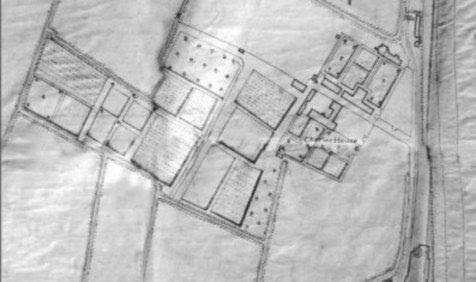
This 1853 map shows the boundaries of the property had been reached and no more accommodation could be built (without using the garden).  In 1863 the plot shown on the map as Clappison's Square was bought for £1,510 and plans drawn up to build 32 rooms and two washrooms on the site, in stages.  To fund this, part of the lands at Hessle was developed; eight "villas" were built and leased out.  By July 1867 twelve new rooms at the Charterhouse were ready for occupation.  There were various proposals for more rooms, and it is not clear which were actually built.  
This drawing by T T Wildridge shows the complex in the 1880s.  
This drawing by F S Smith is from the same period, 1884.
However, plans had been under way since 1881 to expand further.  William Thomas Dibb, the local brewer, had offered the money but wanted to be anonymous, and it was several years before his name was revealed.  Numerous proposals were put forward, including building in the Master's garden, and at the same time concerns were raised at the poor state of the existing buildings.  It was August 1885 when plans were finally approved for 14 new rooms.  They were completed in 1886.
The 1891 map shows the new boundaries and layout.  During the next 40 years the corner of land in the south west was also acquired, and after a great deal of discussion a "recreation room" was built there.  It was the first facility, apart from the chapel, where all the residents could meet, and it closely resembles an old school hall.  It was completed in 1939, and narrowly escaped being commandeered by the RAF for the war effort.  
The whole complex was left empty in 1941 as some bomb damage prompted the evacuation of the residents.  It deteriorated as time went by, and was not made habitable again until 1948.  But the patching up had laid bare how poor the accommodation was.  The conditions became scandalous and in 1960 there was an effort at modernisation.  Most rooms were merged into 2-room flatlets and electric sockets were fitted.  However, it was clear that this was inadequate, and a complete redevelopment was needed.
In the 1970s money for housing was becoming available.  The first use of it for the Charterhouse was the construction of a "new house" in the south west corner.  The records are sparse on this, but it appears to have been built in 1975.   There are two flats and, as always, it is a 2-storey building with no provision for a lift or even a stair lift.  Government money was available only to Housing Associations, so the Charterhouse became an HA, a move which made little difference to the day-to-day running but which enabled it to secure the grants for a complete redevelopment.  The 1780 building could not be demolished because of its listed status, and local planners decided that the 1804 Bourne Wing should also be given that status and spared - a mistake in the view of many.  All the Victorian buildings, however, were reduced to rubble in 1978 and, in their place, modern flats erected.
At the same time, in what we now call Old House and Bourne House, one- and two-bedroomed flats were created out of the existing single rooms.  These have kitchens, bathrooms and modern facilities.  But the buildings have no insulation so heating costs are high.  The western wing of the Master's house, designed originally as servants' quarters and for utilities, was also converted into 4 flats for residents.
All this reconstruction could have been an opportunity for a long-lasting solution to the problems inherent in 2-storey buildings, but it was not taken.  Maintenance of the old buildings is, of course, expensive.
The Charterhouse has been in existence for well over 6 centuries.  The future may well see further evolution of its buildings.


Sunday, 4 October 2020

Suffolk Palace

 Every Hull person is familiar with the old post office building in the city centre.  

It's on the corner of Lowgate and Alfred Gelder Street and was opened in 1909.  It survived the war and later enthusiastic developers and was converted for residential and commercial use some years ago.  Less noticed is a blue plaque on the building.

This was the site of the Suffolk Palace, home of our founder Michael de la Pole, 1st Earl of Suffolk.  The 16th century historian John Leland described it as "a goodly house lyke a palace" and states that Michael built three other houses in the town.  Presumably they were not all for his own use.  The "palace" was not the first house on the site.  Richard Oysel built a dwelling there between 1296 and 1307, and it passed to William de la Pole in 1330.  William's son Michael rebuilt it in 1380.


This image of the palace comes from the Cotton MSS.  The gatehouse-gazetteer website tells us: "An inventory of 1388 refers to a hall, summer hall, great chamber, numerous further chambers, a chapel, two wine cellars, a kitchen, a bakehouse, a granary and two dovecotes amongst various other buildings.  Documentary sources from the mid 16th century describe the building as a mansion and depict it as a series of courtyards bounded by a wall and containing a gatehouse, great hall, and chamber blocks. The four storey gatehouse was built of brick and stone, as was the great hall which had a buttery and pantry to the east with a chamber above and a great chamber to the west. A magazine was recorded on the site in 1642. The majority of the buildings were demolished in the late 17th century, though the gatehouse survived until 1771."  
The plaque tells us that the palace was "seized by the Crown" in 1504.  That would be the point when Edmund de la Pole, 3rd Duke of Suffolk, was accused of treason.  Other authorities put the date as 1513 when he was executed.  As with most of such seized properties, it was leased out for a time before Henry VIII bought it back.  He stayed at the palace for a few days in October 1540 and again in 1541 when he held a privy council meeting there.
Inevitably the complex of buildings fell into disrepair and were demolished, and nothing now remains; only the plaque reminds us of this remarkable palace.


Saturday, 19 September 2020

Henry Kemp

 When John Healey Bromby died in 1868 he was succeeded as Master of the Charterhouse by Henry William Kemp.  At 47 Kemp was relatively young for the job.  He was born in Thanet, Kent, in 1820 and had married Amy Maria Simons in 1847.  They moved to Hull and Henry bought a house on Park Street which he turned into a "classical and commercial academy" with himself as principal.  When his father Isaac died in 1863 Kemp sold the house, which he had called Thanet House, to the Hull Seamen's and General Orphan Asylum charity.  The charity promptly knocked it down and rebuilt it.  Like most other ambitious men of his time Kemp was an active Freemason.  More importantly, he was the incumbent of St John's Church, the church which one of his predecessors as Master, Thomas Dikes, had built.

One of Henry Kemp's first concerns even before his appointment as Master was the reform of the system by which people applied for rooms in the Charterhouse.  People wanting a room had to lobby each of the 56 councillors individually to get their support, and Kemp had spoken against this.  Following an enquiry in 1869 an "Applicants Committee" of councillors and Aldermen was set up.  The new system required would-be inmates to get a printed application form from the Town Hall.  The committee would short-list 6 names, who would then be voted on in a full Council meeting.

As the waiting list grew so did the problem of evicted widows, and this became an increasing concern for Kemp.  Although a few "widows' rooms" were built they were too few to solve the problem.  Kemp suggested what seems the obvious solution - to let the widow take over her husband's room - but the committee did not even consider it.  Other problems built up, and it is difficult to disentangle from the surviving records what Kemp's part in them was.  The councillors seem to have left everything to him, then refused to get involved when he needed their intervention, until finally blaming him when the problems could not be ignored.  The Applicants Committee functioned well enough but there was no other coherent oversight.

By 1879 there was sufficient disquiet among the councillors to prompt a Special Charities Committee meeting "to investigate various matters connected with the management of the Charter-House".  One issue was so-called "back money".  If someone was admitted to a room which had been vacant for a number of weeks, the new resident was entitled to the weekly allowance for those weeks.  That could be a handsome bonus amount.  But it had been customary for the costs of refurbishing the room to be taken out of that back money.  However, it was asserted that some rooms, which were supposed to be repainted every three years, had not been touched for much longer than that.  Other issues of payments which should have been made to residents but were not were raised, as well as a misuse of funds by Kemp.  Neglect of the buildings were alleged, along with the pressing need for water closets.  The committee was unsure of its powers in these matters and decided to study the documents and interrogate Kemp.

The reaction from Kemp was decisive - he'd had enough.  He tendered his resignation, not only from the Mastership but from the ministry.  His fellow clergy asked him to reconsider and on 25 July 1879 he was invited by the residents to a meeting in the garden (the only place, apart from the chapel, where such a meeting could be held).  It was reported the next day in the Hull Times in such detail that we must suspect that the piece was written by Kemp himself:

"I suppose I have not in my life-time suffered more pain than I have during the last three months. I am quite willing to confess my shortcomings as a master. It may be that I have not seen quite so much of my brethren and sisters as they would have liked.  But you know that I am of a somewhat sensitive and delicate turn of mind. I do not like to intrude upon people. I regard each one of your rooms as if it were your own castle. I take no liberty with you of any kind whatever. I do not interfere with your religious freedom in any way, and therefore I think that to a certain extent it was a fault of mine that you did not see so much of me as you might have wished, but in another point of view it was almost a virtue. It
arose out of my delicacy of feeling that you should have perfect liberty of action with respect to your religious professions. Now, of course, I made some practical mistakes. I am quite willing to confess I made a mistake about those coals. At the same time I did not put any money into my own pocket (cries of “No, no”) ................. For the last four years I have worked very hard for this hospital – (hear, hear) – although I have not worked where you might have wished, that is amongst yourselves in your own rooms – but in the management of the estate – and I may say that I have been very fortunate in the management, so fortunate that I thought I should have been able by this time to have increased your pay by at least 1s per week, and I think if I had done so you would have had no reason to be dissatisfied with my management of the hospital (cheers)."
 

The residents begged him to stay, and so Kemp withdrew his resignations.  The Advisers Committee carried out an inspection and made recommendations.  And then in March 1881 came the first hint of what was to be a remarkable act of philanthropy by William Thomas Dibb (see The Benefactor )  and resulted in 14 new rooms.  

In 1886 Kemp was appointed to a canonry in York Minster; but there was a problem in that canons were normally holders of a Masters degree and Kemp was "only" a BA.  So a testimonial was held for him and money raised from local luminaries to buy the degree and the robes needed for the ceremonies.  The testimonial meeting, chaired by Sir Albert Rollitt at the Charterhouse, heaped praise on Kemp.  

Henry Kemp died on 7 March 1888, of diabetes and gangrene of the foot.  Two letters survive from Kemp's son which show one side of an interesting argument about a proposed memorial to him in the chapel.  The family did not want one, insisting that their father would not have wanted the charity's money spent on such a thing.  The councillors must have stated that it was established practice to install such memorials, because the son's response was to give in provided that there was no debate or disagreement about in the committee.  The result is a large brass plaque which we know from later minutes to have cost £45.