Tuesday, 18 August 2020

A relic of the Priory

 It's not everyone's idea of a little light reading; a scholarly article about the provenance of a medieval manuscript.  But this one gives us a rare glimpse of the Priory which was the original Charterhouse.  

Julian M Luxford is Reader in Art History at the University of St Andrews with a particular interest in monasteries.  This article* tells of a manuscript, MS. 142/192, currently in the library of Gonville and Caius College, Cambridge.  It dates from the late 14th or early 15th century and there is apparently nothing remarkable about it.  It isn't "illuminated" with beautiful pictures.  The text is a Latin commentary on the Book of Revelation and it is bound with its original hide-covered wooden covers.  There is nothing obvious to say that it has anything to do with the Hull Priory.  

However, some of the parchment had been erased, or scraped, before being re-used; and under ultra-violet light one line was very clear.  The book is ex libris (from the library of) the Charterhouse of Kingston-upon-Hull.  Only one other manuscript is known with the same inscription, and that is in Lincoln Cathedral library.  Luxford thinks the two books are in the same hand.  Further detective work showed how the Gonville and Caius MS had started life in a different format.  It was intended to be in folio, the large size which would have made it suitable for reading from a lectern, perhaps during meals in the refectory.  But after the scribe had written a couple of sheets on folio parchment the instruction came down to scrub that (almost literally) and make it quarto, or exactly half the size.  Rather than put the folio sheets aside he scraped off the writing, folded the sheets in half and started again.  The result is that the first few sheets of the finished work show ghostly vertical stripes where the original writing was.  Again, much of this shows up under ultra-violet light.  This intriguing book turned up as a bequest to Gonville and Caius College in 1659, and there is no knowledge of where it was between the closure of the Priory in 1539 and this bequest by William Moore.

There is a record, apparently, of three manuscripts granted to the Priory by Richard II in 1387, after Michael de la Pole's attainder.  A list of printed books by John Spalding from the London Charterhouse to the Hull Priory survives, from the late 15th or early 16th century; and there is a record of two other books in a letter of 1717.  But where any of these are now, no one knows.  So the only physical remnants of a once thriving Carthusian Priory are two manuscripts.

* A Carthusian Economy: Gonville and Caius College MS. 142/192, Julian M. Luxford


Monday, 27 July 2020

The aged poor

According to our foundation document the Maison Dieu was intended to house 13 poor men and 13 poor women who were "feeble or old", as an old translation renders the Latin "debilium sive senum".  Google translate now prefers "elderly or infirm".  The "or" is interesting, suggesting that the infirm need not be old.  However, the interpretation seems always to have been that the institution was to house the aged poor.  Thousands of similar almshouses were founded for the same demographic from at least as early as the 11th century.
Those who could no longer earn their own living were always expected to fall back on savings or on the charity of their relatives.  But the poorest have no savings and their relatives, if they have any, are often not in a position to house and feed them.  Charitable institutions were for centuries the only recourse for those whom society regarded as redundant, who were not economically active and who literally didn't count because they were not included in whatever population statistics were occasionally produced.  The "dissolution of the monasteries" in the 1530s wiped out a major provision of care for those in need.  The almshouses which survived were those which, although attached to religious establishments, were endowed as separate foundations, like the Charterhouse, or were founded by trade guilds (e.g. Trinity House in Hull) or private individuals.  
In the Elizabethan period a new "welfare" system was set up based on the parish as the administrative unit.  Local property owners paid a levy, or rate, which the vestry committees then disbursed to those in need.  Nobody wanted to go "on the parish" (a phrase still occasionally heard in the mid-20th century) but if they were granted "parish relief" they were classed as paupers and granted an allowance at subsistence level.  Workhouses or Charity Halls were set up for those of all ages who could not provide accommodation for themselves; these did not carry quite the stigma they were later to acquire.  At the same time the number of almshouses increased, especially for the aged poor, giving dignity and security to the elderly in need.
For various reasons the welfare system had to be reformed by the 19th century.  The 1834 Poor Law Amendment Acts resulted in an explicitly punitive system under which the aged poor suffered more than most.  Couples who had been together for many years were split up in the workhouses.  What was known as out-relief - the payment of an allowance whilst not having to enter the workhouse - was supposed to be forbidden but was quite common in some areas, as the censuses show.  But it is also common to see men well into their 70s listed as working in various trades.  Clearly many struggled to earn a living far into old age in order to avoid the workhouse.  We have a good example in Richard Haworth, whose begging letters to a Hull acquaintance survive.  Richard, living in London, tried to earn a living as a clerk, apparently on a casual basis, until he was over 80, but couldn't make ends meet and for some years had to borrow money from his better-off friends, money he never repaid.  The long-suffering Samuel Lightfoot reluctantly stumped up the cash until, in December 1861, Richard was awarded a room in the Charterhouse, for the third time of asking, at the age of 82.  He died a year later.
Almshouses provided more than accommodation.  Some, like the London Charterhouse, provided meals as well, as it still does.  The rest gave a weekly allowance of money and fuel.  In our Charterhouse the  fuel was coal and turfs.  The allowances could be varied to take inflation into account, although often there was a lag, a delay in raising the payments, which caused hardship.
The 20th century brought huge social changes which improved the circumstances of the "aged poor".  First came the old age pension in 1909, which was a life-line for many, enabling them to stay in their own homes.  Just as important, the pension was a right, not charity.  The concept of "social security" (not "welfare") gave dignity to millions.  But it caused complications for almshouses, which had to try to take into account what pension income and, later, rent allowances, people were receiving.  They could find themselves paying very different allowances to all their residents.
The early part of the century also saw the beginning of council housing, supplementing the provision by housing trusts and establishing an increasing stock of cheap, decent and secure homes.  This was supplemented from mid-century by council-owned residential care for those who couldn't cope in their own homes.  This enabled almshouses to stop providing nursing care.  But in some cases, including at the Charterhouse, it led to an apparent eagerness to pass time-consuming residents on to the care of councils.  
The financial complications were finally sorted out at the Charterhouse in 1962 with a revision of the Scheme of Governance which ended the payment of allowances; instead, residents would pay 5/- per week “towards the cost of maintaining the Charterhouse”, and pay for their own fuel and lighting. The scheme came into effect on 1 April 1962, and the National Assistance Board was asked to
interview residents to consider their needs. The Board reported back that everyone was catered
for, but the weekly charge for fuel was set at 7/6d a week rather than the full amount.
From the 1962 scheme
The 20th century changes meant an end to the huge waiting lists for almshouse accommodation, although there was always sufficient demand to justify their existence.  And in the 21st century that demand is rising again.  New almshouses are being built in several parts of the country, with charitable organisations again supplying what the state is failing to provide.

Monday, 29 June 2020

Fighting corruption in the charity sector.

I have been re-reading Anthony Trollope's novel The Warden after many years, and realised that it is based on real events.  Following up on those real events has thrown light on what happened to the Charterhouse.
It was common for centuries for those with money to found almshouses or schools (or both) in their wills for the benefit of people in their local areas.  They would bequeath land, the rents from which would fund the institution, and they would specify details such as numbers to be accommodated, what provision was to be made for them, and who would be in charge.  Someone had to oversee the execution of these provisions, and it was often the church.
Many of the almshouses founded before the Reformation were attached to abbeys or monasteries and were closed when those establishments were dissolved.  The Charterhouse survived because it was a separate foundation with its own income, but it passed into the supervision of the local bench, the town's governing body.  The bench appears to have taken little interest in it until 1571, when Robert Armyn blew the whistle on what had been happening.  Unsure what their role was, the Aldermen decided to refer the matter to the Archbishop of York in a petition quoted by Tickell:
"That whereas one Thomas Turner, clerk, has been by the space of thirteen years now past, and yet is master of the hospital of the late dissolved Charterhouse near Kingston-upon-Hull, in all which time the said Thomas Turner has done, and yet openly doth, by divers and sundry ways, misuse the said hospital, contrary to the foundation thereof; not only in receiving and admitting thither, such as be neither halt, lame nor blind; but such as are well to live in the world, and have plenty of money, so as to let it out for usury.  As also in letting out of leases of such lands and tenements as belong to the hospital; as well in reversion as by surrender of the old leases, and that for many years, and taking great fines, and incomes for the same.  And also doth misuse the same by divers other means; as to your Grace shall manifestly and plainly appear.  We beseech your Grace (the premises considered) the said Thomas Turner may be examined and sworn upon his oath truely and distinctly to answer to all such articles, and to every branch and member of the same, as are herewithall exhibited; whereby not only the truth of the premises may appear, but also the same may be restored to the right and true foundation.  And your said orators shall duly pray to God, long to preserve your Grace in health and wealth, with much increase of virtue and gladness.
Christ. Stockdale, mayor"

The Archbishop replied to the effect that it was nothing to do with him, and they should sort it out themselves.

The petition expresses the problem that was building up in many charitable foundations. Without adequate supervision and regulation those in charge were able to siphon off the money for themselves and for people who were far from being the intended recipients. The Hull Bench responded by summoning Turner and confronting him with a long list of rules which he was made to sign up to, including submitting annual accounts. That worked for a while, but in the rather patchy records we have we can see the problem recurring time after time. 1671 the Master Richard Kitson was made to sign articles of agreement with the Bench but there were continual disputes over the finances in his time. In 1716 John Clarke began his 52-year Mastership. His struggles with the Bench over that time are well documented. What powers did the Master have and what should his pay be? Eventually the Bench was driven to take their case to the Court of Chancery in London in 1764, paying a total of £1,053 of the charity's money to achieve a settlement.
The Court of Chancery was the only recourse for anyone disputing the conduct of charities in this period, and it could take years to get a settlement. This allowed bad practice and corruption to flourish. There were grammar schools without scholars, the money going into the pockets of the trustees. There were almshouses where the trustees themselves leased the lands which formed the endowment at a fraction of their value, or borrowed money from the charity's funds. The impulse for change came from the MP Henry Brougham, who, after a struggle, got a Select Commission on Public Charities formed in 1831. It conducted a survey of nearly 30,000 charities and produced a massive report between 1837 and 1840.
Henry Brougham

This fits with the records we have about the Charterhouse. A commission looking into local government finances came to Hull in 1834 but asked only one question about the local hospitals i.e. almshouses. The answer came back to the effect "I thought you weren't going to ask about that". A separate enquiry was clearly in the offing. A document which we can date to 1836 is a meticulous hand-written booklet listing all the inmates of the Charterhouse, the date of admittance, age at admittance, whose "gift" they were, i.e. which Alderman had nominated them and notes about their circumstances. A final column in the table is in a different handwriting by someone who has checked by means of personal interviews if the information is correct. What is revealed in the document is corruption in the awarding of rooms. What we don't know is whether there was financial mismanagement going on. Certainly the number of beneficiaries was being maintained, and increased well beyond the 26 stipulated in the founding charter. But the revelations prompted the Aldermen to clean up their act, and a register of new inmates was started.
Brougham fought for the establishment of a permanent Charities Commission, but for many years Parliament would not back it. Meanwhile, huge social changes saw the need for almshouses and many other charities grow. The Hull Charterhouse more than doubled in capacity by building new rooms while the value of its endowment grew. In 1847 the councillors decided to be as transparent as possible by publishing the names on the waiting list and setting up a sub-committee to decide on admissions. But genuine reform of charities and a permanent Commission was opposed by the Church, by the courts and by municipal corporations, which were said to be among the most corrupt institutions. A permanent Charity Commission was finally established in 1853, but with watered-down powers, and blatant corruption among charities continued.
The Charterhouse did have run-ins with the Commission over changes it wanted to make, particularly in respect of the role of the Master. The councillors wanted to change the job to that of a chaplain on lower pay. The Commissioners held fast to the terms of the original foundation and the 1764 settlement. Terse responses from the Commission to the councillors' arguments are in the archives, and the anger is clear when the Commissioners eventually insisted on a new scheme of governance in 1901.
The modern Charity Commission is a much larger body with many more charities to regulate. No doubt corruption still exists so it is more important than ever.

Saturday, 25 April 2020

Arthur Kent Chignell

The Master of the Charterhouse with the most unusual CV was Arthur Kent Chignell.  He was born in Leighton Buzzard, Bedfordshire, in 1870.  His father was William Henry Chignell who described himself on the 1871 census as a professor of music.  This was an exaggeration.  In 1874 in bankruptcy proceedings he was simply an organist and piano tutor.  After university Arthur became a priest in the Church of England.  In 1893 he was in America and then sailed to Sydney, Australia.  On the leg from Honolulu to Samoa on board the Mariposa he had an interesting time with Robert Louis Stevenson, which he described in a letter to his brother Norman in 1938.  He spent much of the voyage in the company of the writer and his wife.  Arthur said that he didn't realise at the time what a privilege that had been, especially as Stevenson died the following year.
Around the turn of the century, Arthur became Rector of Wallaroo in Australia, where his mother was his housekeeper.  From there he went to New Guinea as a missionary, where he spent seven years.  In May 1914 he learned that his mother had been lost in the Empress of Ireland disaster.  On 2 September 1914 he married Elizabeth Rattigan (a nurse who worked in the same mission) at his church in Samarai, Papua.
In 1911 Chignell published a book, An Outpost in Papua, about his experiences.  He writes vividly about the people, and his affection for them is clear.  His attitude was a little too tolerant for some of his readers, although they seem patronising today.

He published a second book, a history of the New Guinea mission before returning to England with Elizabeth in October 1914.  He seems to have spent a few years in the south where his first three children were born, before applying for the job at the Charterhouse in 1919.  Perhaps the fact that his brother Philip was then living in nearby Hessle influenced his decision.  He got the job and was to be Master for 32 years.
He also had a second job.  In June 1924 he was appointed Chaplain for the Board of Guardians, at a salary of £50 a year.  In April 1927 the Board decided he should resign for failing to carry out the duties he was paid for (they had no power to sack him).  The matter rapidly escalated, and in July a Ministry of Health representative came to Hull to carry out an investigation, which was well covered in both the Hull Daily Mail and the Yorkshire Post.  Chignell was accused of ignoring "danger notices"; the job required him to attend on all workhouse inmates who were seriously ill, and he had put in very few appearances.  He argued that some of the proposed visits would have been pointless, and that there should have been a full-time doctor rather than a part-time chaplain.  Chignell got something of a mauling.  The Mail's report ends with "(Proceeding)" but there were no more stories about the case so we don't know the outcome.  It's impossible to know if the case did permanent damage to his reputation.
In November 1924 Chignell sent an intriguing letter to the Hull Daily Mail.  It appears that a group of students from the Art School were in the Charterhouse painting the chapel.  The head of the school, J J Brownsword, had produced grandiose and expensive plans for murals, including a frieze of "angel faces" and decoration around the pulpit and the doorway.  He also wanted an electric light in the dome to highlight his creation, and elaborate hangings.  Chignell knew that he could not ask the trustees to pay for these so he was asking for public contributions.  There is no follow-up to this and nothing in our records, so perhaps the trustees, mercifully, took the view that it was all rather tasteless and none of it materialised.
A photograph taken in 1930 shows Arthur (left) in the garden of the Charterhouse with his brothers Philip and Norman.  Through the 1930s Arthur found himself short of money.  His salary was well below the normal clerical stipend, and the Charity Commission had ruled that the Mastership was a part-time job and denied him a pay rise.  Chignell supplemented his income by writing for the local paper, editing books and taking Sunday duties in local parishes, but the war put an end to many of those opportunities.  He spent the first months of the war battling unsuccessfully with the Surveyor and trustees to get a proper air raid shelter for the residents.
On 7 May 1941 during a heavy raid on the city a bomb fell close to the Master's house, causing considerable damage, and also causing blast damage to the Charterhouse itself.  Chignell was in bed in his own shelter at the time, described by his brother Philip as "an underground dugout where he keeps his books and his wireless".  He was unhurt and so were residents, but it was the beginning of the end.  Chignell (and, presumably, his wife Elizabeth, though she is never mentioned) moved temporarily into rooms in the main building and the evacuation of the residents began.  For the rest of the year the Master compiled and printed a monthly list of the whereabouts of those residents.  But neither the Charterhouse nor the Master's house could be repaired until after the war.  In fact, it was 1948 before the main buildings were restored and reopened, and Chignell ended his days in rooms there, the house not being rebuilt until 1956.
In 1949, nearing 80 years old, Chignell suggested that he would like to retire but couldn't afford to, and would stay on if he had an assistant.  While the trustees were willing to pay for this the Charity Commission would not give permission, saying rather brutally that if he couldn't do the job he should retire and that there would be no salary increase until a new Master was appointed.  The trustees tried at first to add £150 pa to Chignell's £300 salary (£300 is worth about £12,000 in today's values) but when the CC vetoed this as well they apparently ignored them and Rev Ronald Helm was taken on as Chignell's assistant.  
Rev Chignell on left, Rev Helm on right, 1951
This photo, taken early in 1951, is the last we have of Arthur Kent Chignell.  He died on 25 June that year.  His wife, Elizabeth, died two years later.  Chignell's legacy is that the western end of the rebuilt Master's House was later converted into flats for residents and named Chignell House.


Tuesday, 17 March 2020

Epidemics

It's a frightening time for those of us at the Charterhouse, with the majority of us over 70.  So it seems appropriate to look at how various epidemics affected the hospital through the centuries.  But there's a problem; there is absolutely nothing in the records about it.  Is that because the hospital's inmates escaped unscathed, or simply because no one bothered to record any impacts?
Frequent epidemics of disease were a fact of life.  Thirty years before Michael de la Pole founded his Priory a huge number of people in England had died of the plague, and that disease was to flare up occasionally right through to the 17th century.  There is information in the 16th century Bench Books about its effects in Hull, but no mention of hospitals like the Charterhouse.  In 1575 an outbreak of plague caused the Bench to confine all the poor to their houses, since they were the ones thought to be spreading it.  A tax was levied to pay for their upkeep.  Presumably almshouses were under the same lock-down.
It is possible that there was safety in being relatively isolated and self-sufficient outside the city walls.  But when the plague struck Hull again in 1637-8 the hospital at last gets into the records, because the Master was affected.  Andrew Marvell and his wife were suspected of having caught the disease and were quarantined in the home of Alderman Maccabeus Hollis for 14 days.  They were cleared.  One estimate is that 2,000 people in the town died, a huge part of the total population; at least 2,500 survivors had to apply for financial assistance; and many left the town altogether.  The Charterhouse, which had 18 residents and an income of £133.7s.6d., in 1638 gave a donation of £56 "to the poor in general on account of the pestilence".
An ever-present problem in the city was poor drainage, because the land is so flat.  (This still poses difficulties for modern sewers.)  Complaints about the drains recurred at the Charterhouse.  The situation almost certainly contributed to the numerous outbreaks of diarrhoeal disease; there was a particularly severe epidemic in 1884/5.  However, no spike in deaths of Charterhouse inmates is evident from our register.
This is also true of the two major cholera epidemics.  Cholera is a water-borne disease, but it is
James Alderson
thought that it as brought into England on infected rags, and Hull was particularly badly affected.  Around 300 people died.  Quarantine and other public health measures had been put in place rather reluctantly because the city's rulers didn't want to damage trade.
James Alderson MD wrote a History and Progress of Cholera at Hull, an account of his own experience in the 1832 epidemic.  He mentions the Infirmary, the gaol and the new workhouse, noting that measures had been taken, such as cleaning, to minimise the risks.  He doesn't mention the almshouse-type hospitals.  Alderson's work was vital in understanding the disease.  But lessons were not learned.
The next big epidemic occurred in 1849, and its affects were far worse.  1,834 people died in Hull and Sculcoates.  The outbreak is well documented.  Henry Cooper MD published a paper on it in 1853.  He gives detailed figures for deaths (but not percentages, which seem not to have been used in this period) but this doesn't help us to know what was happening at places like the Charterhouse.  (He also presents an interesting analysis of what was wrong with the drainage system in Hull.)  Our register again gives little indication of a spike in deaths.

In June 1918 Hull experienced its first case of what became known as Spanish flu.  The epidemic lasted almost a year and resulted in 1,261 deaths, across all sectors of the community.  The Charterhouse records don't mention the outbreak, but presumably it was as badly hit as the rest of the population.  The elderly residents would have been particularly susceptible.

We are now in the early stages of an epidemic, covid-19,  which could be the worst yet, and we, of course, don't know what will happen.  If I'm spared, I will try to update this post.

Thursday, 20 February 2020

Lady Alice and the Hull foundations

How much involvement did the de la Pole family have in the life of the priory and hospital that Michael de la Pole founded?  Records of the early priory and hospital are sparse.  Michael rarely visited Hull in what remained of his turbulent life.  We know that in 1408 the 2nd Earl of Suffolk, Michael's son, granted further extensive lands to the hospital.  But after his death in 1415 at Harfleur, and his son's a month later at Agincourt, it was the 4th Earl, and 1st Duke, William, who inherited the responsibility for the Hull foundations.  Did he take an interest in them?
The Cloisters at Ewelme
William had as turbulent a life as his forebears.  But he married Alice Chaucer (granddaughter of Geoffrey Chaucer) and the couple made their home at Ewelme in Oxfordshire.  In William's frequent absences it was Alice who oversaw the foundation of an almshouse there for 13 poor men, together with a school.  The almshouses survive to this day.  On 2 December 1439 William himself granted the manor of Rimswell in East Yorkshire to his Carthusian priory near Hull.  William was killed in 1450 and his remains delivered to his widow.  Although Bulmer's Gazeteer of Hull in 1892 states that in his will he desired his "wretched body to be buried in the Charter House at Hull", he was in fact buried at the family estates at Wingfield in Suffolk.  His son John was still a minor and it was Alice who took the reins.
A hugely informative book was published in 2001, God's House at Ewelme by John A A Goodall [pub Ashgate Publishing Ltd].  Among the archives that Goodall studied was a single sheet relating to the Hull priory.  It's amazing that it survived at all; it is water damaged and is a draft of an indenture, written in abbreviated Latin and much corrected.  Goodall states that it is very hard to read and translate, but offers the following translation:
To all the Christian faithful to whom this written indenture shall come, Henry, Prior of the Carthusian house of St Michael beside Kingston upon Hull and the convent of the same, greetings in the Lord.  The late William de la Pole gave to the late Prior, John Gannesfeld, and the convent in perpetuity the manor of Rimswell in the County of Yorkshire with its appurtenances on 2 December 1439, by licence of the King.  Out of consideration of the devout and pious intentions between us and the late Duke and the venerable lady and princess, Alice, Duchess of Suffolk, his wife, we grant that one monk of the house shall, every Friday, during the life of the Duchess, read, and say the Seven Penitential Psalms and a Mass with the office Reministere, celebrated specially for the good estate of the Duchess and her son, the prince John, now Duke of Suffolk.  We grant, moreover, that from this time forward we will celebrate in perpetuity the anniversary of the aforesaid Duke and also the Duchess, when she has died.  Beyond this we agree also that in the near future we will have made two stone images, one in the likeness of the Duke and the other in the likeness of the Duchess, the which shall bear on the right hand a disk, in symbol of bread and fish, and on the left hand an ale pot, in sign of a measure.  These images shall stand in an eminent place in the refectory of the said convent for ever.  In the presence of these images, I, the aforesaid Henry, and my successors as priors of this house, or our procurator or our representatives if we are ill or indisposed, shall distribute two messes of drink, fish and bread in perpetuity to a maximum of two almsfolk, according to our discretion.  That is to say to a man and to a woman, two conventual loaves, each weighing one and a half pounds, and two conventual measures of ale containing two quarts each.  Conventual messes according to this form shall be made on Sunday, Tuesday, Thursday and Saturday, except in Lent and on Monday, Wednesday and Friday, when fish shall be provided.  These messes shall now and for ever be the same as those of two monks, except on the days when the Carthusian rule demands abstinence from fish.  On those days the poor shall not be deprived of their messes.  In respect of our distribution of food to the two paupers they are to offer prayers for the souls of the Duke and Duchess, their ancestors, parents and all the faithful departed.  If we fail in the discharge of any of the above duties we will pay £10 to the Duchess and her successors and forfeit the manor of Rimswell and its appurtenances as they have been described.  In testimony of which thing we keep one part of this indenture, sealed by the Duchess, while the other part remains with her, sealed with the conventual seal, given in our chapter on 1 October 1462.
This document contains the only mention of a convent in the records we have; but this was frequently used for an all-male religious establishment.
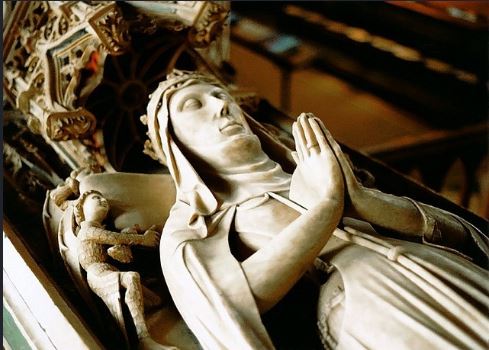
Alice wanted herself and William to be remembered in statues and in the giving of food and drink to the poor, paid for by the income from the manor of Rimswell in East Yorkshire.
Alice's tomb in Ewelme church
Even more interesting than the information about the priory is what is "scribbled" - Goodall's description - on the back of the sheet.  It's a list of the poor men and women in the "New Hospital", the neighbouring almshouse.  Alice had the right of presentation to this; effectively, she had to give her approval.  Disappointingly, Goodall does not give all the names.  This is part of his transcription:
Names of men are listed with a note of their physical health - "sturdy and powerful" or "young and ill" or "poor and old" - and the name of what appears to be a sponsor.  So "able and powerful" Richard Grawngby was appointed at the "instance" of a certain John Hastmore; two men were appointed "by the will" of the Prior of the Charterhouse, one "by" the late Master Peter of the foundation; and the "powerful" William Malyard at the "instance" of G. Crysto and the present Master.  Two men apparently have no proposers - the "poor and old" John Beanghorn, who heads the list, and John Hadelsey, who ends it.  The women are not individually named - there were eleven, five "debilitated" and six "young and strong".  Beneath is a sentence reading "none of these are tenants of my Lady and one, called Joanna Mayre, was lately received without the licence of my Lady".  A note under this list reads: "memorandum of John Campyon comorante per le North feyre in Hull, faithful tenant of my Lady for 25 years, old and debilitated".
Campyon appears to be someone whose place awaited ratification.
The system appears to be that to get a place in the hospital the applicant needed the support of someone prominent such as the Master or a de la Pole servant.  It helped to be a tenant of de la Pole lands but was not essential.  The Duchess had the last word, signing off the names, but usually after they had been admitted. 
This scrappy document provides a fascinating glimpse of the continuing relationship between the de la Pole family and the foundations of their forebear, the 1st Earl of Suffolk.  And it gives us the names of the earliest inmates to emerge as real people.

Wednesday, 29 January 2020

In the 19th century news

When a name on our 19th century register is uncommon, a trawl of the local papers on the British Newspaper Archive, together with the usual genealogy sites and search engines, can turn up some interesting potted biographies and social history.

Take Cornelius Kingdom.  He was born in Hull in 1851.  He crops up in the Hull papers first in December 1867.  He was apprenticed to the owner of a Hull fishing smack, but absconded and was caught in Grimsby.  He was sentenced to 7 days in prison.  He must have decided that a life at sea was not for him and on the 1871 census he was a fishmonger.  At some point he went back to fishing.  He next turns up in November 1894 as the skipper of the steam trawler Madras.  The boatswain had a bad accident while they were at sea and Kingdom had to return to Hull.  A journal published in 1900 tells us that the Madras was the first Hull trawler to have a the otter trawl fitted, with great success.  But in 1901 the vessel was involved in two collisions with other trawlers, in the Humber in calm conditions, and after the second the Madras foundered without loss of life.  We can't be sure that Kingdom was still the skipper at this point.  His last mention in the news came in 1904 when he was in command of the steam trawler Jed.  It was involved in what became known as the Russian outrage, when the Russian Navy attacked the British trawler fleet by mistake.  Kingdom and his ship apparently were unscathed.  But he left the fishing life and the 1911 census describes him as a general labourer.  In February 1924 he was admitted to the Charterhouse and died two years later.

An earlier resident, Samuel Mozeen, had a very different life.  Born somewhere in Yorkshire in around 1799, he was apprenticed to gunsmith George Wallis Jnr, the son of a famous gun maker who had taken over the business when his father died in 1803.  When Wallis junior died in 1833 Mozeen advertised that he had taken on the business at the same Mytongate premises.  Shortly afterwards he took over from another famous gunsmith, John Blanch Jnr, at 26 Silver St.  Mozeen did not advertise again until late in 1849, when he announced that he had sold all his stock to William Needler of Scale Lane.  A year later he was awarded a room in the Charterhouse; the register says he was 54, though he was probably a couple of years younger.  Either way, he was too young.  He died in July 1850.

Cornwell Baron didn't appear in the papers very often, but when he did it was for the wrong reasons.  Born in 1785 in Ulrome, he went into business as a timber merchant, with a partner, but went bankrupt in 1810 and 1812.  By 1819 he was insolvent again and imprisoned for debt.  In July 1833 a very small item appeared in the Hull Packet: "Cornwell Baron (47) was charged with embezzling certain sums of money, namely £3 5s.4d. and £2 10s."  On the 1851 census he is described as a merchant's clerk, and lived in Providence Row, Walker St.  His wife Elizabeth died in 1853, and Cornwell was admitted to the Charterhouse in July 1854.  He died on 21 Mar 1862, leaving a will but effects of less than £20.

One of quite a few Charterhouse men in the clothing trade was tailor and draper Robert Bellard.  He was born in 1785 in Welton near Hull and christened in Swanland Independent church, so came from non-conformist stock.  His first advertisement appeared in the Hull Packet in April 1819.  His shop is at 14 Bridge St.  He says that he just returned from London with the latest fashions (dubious, but all the tailors and dressmakers said it) and various kinds of cloth the names of which mean nothing now.  In 1821 his ad reported that he had moved to Dock Office Row, and his ads in subsequent years show that is where he stayed.  In 1845 he said that he had taken on a cutter.  There are no more newspaper advertisements, and he was admitted to the Charterhouse in January 1856.  He died in 1858.

Theophilus Routledge was another tailor, but of menswear.  Born in Easington, Co Durham, in 1827, he was in Hull by 1851, staying with his older brother John on Hessle Rd.  Both were tailors, although the census says that Theophilus employed 6 men and John only one.  They appear to have been rivals rather than partners.  The only advertisements that Theophilus placed were all in 1854, when he had premises at 32 Queen St as a "merchant tailor, hatter and gentlemen's outfitter".  The first ad offered an Aberdeen hat (?) for 12/6d.  The other two, both in December, promote a raglan cloak with sleeves, and a reversible overcoat.  Routledge was still described as a tailor in 1871 and 1881, but is in lodgings in East Hull, and had perhaps fallen on hard times.  He was admitted to the Charterhouse in December 1893 but in February 1901 he was "removed for drunkenness" and went to the Willerby Asylum, where he died in June 1901.

Born in 1802, Michael Parker worked for 25 years for the W & J Walker iron works before announcing in the spring of 1849 that he was setting up in business as an ironmonger on his own account at 32 Scale Lane.  A year later he moved to 75 Lowgate ("four doors from the Town-hall" as his ad pointed out).  He seems to have concentrated on bathrooms and showers.  In 1855 he expanded into premises with "commodious and elegant showrooms" at 57 Lowgate and had taken over another local firm.  Perhaps he overreached himself.  January 1857 he was advertising a large variety of goods.  But By 1857, however, he was bankrupt, with his valuable stock being sold at auction.  He climbed out of bankruptcy in 1859 and started up his business again.  But it didn't last.  He was bankrupt again in 1865.  His wife died in the same year.  But he was back in business as a "tinner" by 1871, and a supplier to the Workhouse.  We next hear of him when he was admitted to the Charterhouse in February 1879.  He died in December 1884.