Friday, 27 November 2020

Paupers' Graves


Most of the Charterhouse residents who are recorded in our 19th century register, like those who died in earlier centuries, have no marked graves.  Many were laid to rest in the Hull General Cemetery, their graves recorded but with no headstones.  The Sculcoates workhouse had a contract with the cemetery to bury their dead in the pauper's section (left) but almshouses like the Charterhouse had no such contract so their graves are more scattered.  Funerals and burials cost money so were carried out as cheaply as possible.  In 1862 the Master's daughter, Emily Bromby, wrote a begging letter to a contact of Richard Haworth for the £2 it would cost to have this inmate "respectably" and "decently" buried.  Even if an inmate left enough money for the funeral there would rarely be a headstone.

An exception was when there was an existing grave of a family member, and the deceased could be interred in the same grave and an addition carved on the headstone.  That has helped to rescue at least one resident from obscurity.  Jane Foster appears on our register with the bare details.  She was admitted on 9 September 1876 aged 76 and died on 27 December 1878.  We can be sure from that simply that she was either a widow or a single woman or she would not have been given a room in her own right.  But the name is too common to enable us easily to find out more about her.  Until, that is, Bill Longbone of the Friends of Hull General Cemetery turned up a gravestone.

It was hard to photograph but the details are clear.  Jane was the widow of William Foster, who died in 1855.  We have enough information to find out more about her.  She was born Jane Richardson in Hull and married William Foster of Hull on 30 June 1823 in Rise, East Yorkshire.  William was a brewer and by 1841 the couple were living on Vincent St, Hull.  In 1851 William was employing two "hands" and they had a domestic servant.  They also had two daughters.  His small brewing operation was apparently moderately successful.  On 5 March 1852 a court case was reported in the Hull Packet; William had been the victim of a robbery.  The thief had stolen a gold watch, a gold chain and a hat.  
After William's death it seems that Jane did not try to carry on the business.  In 1861 she was living on Shaw St, Drypool, with her daughter Harriet and Harriet's husband, and was described as an annuitant, i.e. a pensioner.  By 1871 she was a lodger, along with another annuitant, in the home of a mariner.  Five years later she got a room in the Charterhouse.
I have compiled a database of 1,179 Charterhouse residents - a small fraction of the total.  All of them, like Jane Foster, were interesting individuals who deserve to be remembered as part of our social history. 


Thursday, 29 October 2020

Growth and change - the evolution of the Charterhouse buildings

 In six and half centuries the almshouse which became the Charterhouse has inevitably seen many changes, from the major upheavals of the Reformation and the Civil War to the gradual adaptations to the society in which it is set.  The most obvious changes have been to the buildings.  But there are huge gaps in our knowledge.

The earliest image is from 1640, just two years before the first demolition.  The writers of the Conservation Area report labelled it to show the hospital buildings on the eastern side, nearest the river, with the remains of the old priory to the west.  It's hard to make out the detail (or to be confident of the image's accuracy) but this places the almshouse in much the same spot as now.  We can see the path down to the river where, later, a roadway would be built.


All the buildings were demolished in 1642, and new ones were erected after the Civil War.  It seems that this happened in two phases, the first from 1649 with further development, including a chapel, from about 1673.  This detail from a map of 1715 , with its label "Charterhouse" on the southern side of the complex, leads to the conclusion that the orientation of the buildings had been changed.  However, it is believed that the Master's House (which still stands, albeit much reconstructed) was built during this period, which would mean that the label was misplaced.

The only image of the buildings in this period comes from John Cook's 1882 history of the Charterhouse.  It's a bit of a puzzle since the perspective is odd.  We can't tell how many inmates it would have housed.  The number of residents certainly fluctuated through the years.  The original charter stipulated that there should be 13 poor men and 13 poor women, but that was the only clause in the charter which was routinely ignored.  There were often far fewer than 26 inmates, especially during the post-Reformation years when the Masters were left to their own devices and were sometimes either lazy or corrupt.  There is no record of whether the 17th century rebuild was an opportunity to expand the hospital's capacity.

The rebuilding in 1780 provided rooms for 44 inmates.  The greater the number of inmates, the higher the cost to the charity, of course, but there was soon a move to build more accommodation.  In 1804 a new wing was built on the eastern side of the main building at the rear.  Named the Bourne Wing after the Master, it housed 14 residents (some sources say 16, but this seems unlikely).  
The rooms in Bourne Wing followed the style of those in the main block.  They were architecturally of their time but took no account of the fact that their occupants were all elderly and many were infirm.  Their very high ceilings, with windows to match, made such matters as window-cleaning and hanging curtains impossible without help.  Half of the accommodation was on the first floor, with their residents often trapped, in their later years, by their inability to negotiate stairs.  There were few handrails.  Unfortunately, all the subsequent extensions followed the same pattern.
There was plenty of room to expand further.  On the south side was a huge garden behind the Master's house, but this was, apparently, sacrosanct.  There was space to the north but no money, until, in 1840, a chunk of the Hessle lands was sold to the Hull and Selby Railway Company for over £506 (c. £30.5k today).  With nearly £1,060 in the bank (£64k) the Master, Thomas Dikes, got permission for a new block of 12 rooms, each measuring 15ft x 12 ft, which were ready for occupation in 1845.  Six of these were intended for widows of of deceased residents, but in the end only three of them were needed for that purpose.
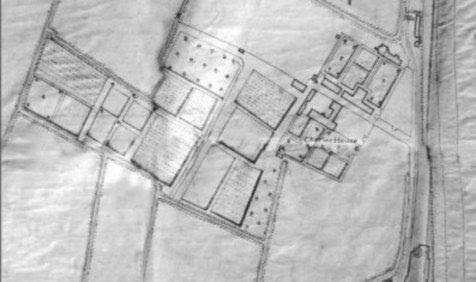
This 1853 map shows the boundaries of the property had been reached and no more accommodation could be built (without using the garden).  In 1863 the plot shown on the map as Clappison's Square was bought for £1,510 and plans drawn up to build 32 rooms and two washrooms on the site, in stages.  To fund this, part of the lands at Hessle was developed; eight "villas" were built and leased out.  By July 1867 twelve new rooms at the Charterhouse were ready for occupation.  There were various proposals for more rooms, and it is not clear which were actually built.  
This drawing by T T Wildridge shows the complex in the 1880s.  
This drawing by F S Smith is from the same period, 1884.
However, plans had been under way since 1881 to expand further.  William Thomas Dibb, the local brewer, had offered the money but wanted to be anonymous, and it was several years before his name was revealed.  Numerous proposals were put forward, including building in the Master's garden, and at the same time concerns were raised at the poor state of the existing buildings.  It was August 1885 when plans were finally approved for 14 new rooms.  They were completed in 1886.
The 1891 map shows the new boundaries and layout.  During the next 40 years the corner of land in the south west was also acquired, and after a great deal of discussion a "recreation room" was built there.  It was the first facility, apart from the chapel, where all the residents could meet, and it closely resembles an old school hall.  It was completed in 1939, and narrowly escaped being commandeered by the RAF for the war effort.  
The whole complex was left empty in 1941 as some bomb damage prompted the evacuation of the residents.  It deteriorated as time went by, and was not made habitable again until 1948.  But the patching up had laid bare how poor the accommodation was.  The conditions became scandalous and in 1960 there was an effort at modernisation.  Most rooms were merged into 2-room flatlets and electric sockets were fitted.  However, it was clear that this was inadequate, and a complete redevelopment was needed.
In the 1970s money for housing was becoming available.  The first use of it for the Charterhouse was the construction of a "new house" in the south west corner.  The records are sparse on this, but it appears to have been built in 1975.   There are two flats and, as always, it is a 2-storey building with no provision for a lift or even a stair lift.  Government money was available only to Housing Associations, so the Charterhouse became an HA, a move which made little difference to the day-to-day running but which enabled it to secure the grants for a complete redevelopment.  The 1780 building could not be demolished because of its listed status, and local planners decided that the 1804 Bourne Wing should also be given that status and spared - a mistake in the view of many.  All the Victorian buildings, however, were reduced to rubble in 1978 and, in their place, modern flats erected.
At the same time, in what we now call Old House and Bourne House, one- and two-bedroomed flats were created out of the existing single rooms.  These have kitchens, bathrooms and modern facilities.  But the buildings have no insulation so heating costs are high.  The western wing of the Master's house, designed originally as servants' quarters and for utilities, was also converted into 4 flats for residents.
All this reconstruction could have been an opportunity for a long-lasting solution to the problems inherent in 2-storey buildings, but it was not taken.  Maintenance of the old buildings is, of course, expensive.
The Charterhouse has been in existence for well over 6 centuries.  The future may well see further evolution of its buildings.


Sunday, 4 October 2020

Suffolk Palace

 Every Hull person is familiar with the old post office building in the city centre.  

It's on the corner of Lowgate and Alfred Gelder Street and was opened in 1909.  It survived the war and later enthusiastic developers and was converted for residential and commercial use some years ago.  Less noticed is a blue plaque on the building.

This was the site of the Suffolk Palace, home of our founder Michael de la Pole, 1st Earl of Suffolk.  The 16th century historian John Leland described it as "a goodly house lyke a palace" and states that Michael built three other houses in the town.  Presumably they were not all for his own use.  The "palace" was not the first house on the site.  Richard Oysel built a dwelling there between 1296 and 1307, and it passed to William de la Pole in 1330.  William's son Michael rebuilt it in 1380.


This image of the palace comes from the Cotton MSS.  The gatehouse-gazetteer website tells us: "An inventory of 1388 refers to a hall, summer hall, great chamber, numerous further chambers, a chapel, two wine cellars, a kitchen, a bakehouse, a granary and two dovecotes amongst various other buildings.  Documentary sources from the mid 16th century describe the building as a mansion and depict it as a series of courtyards bounded by a wall and containing a gatehouse, great hall, and chamber blocks. The four storey gatehouse was built of brick and stone, as was the great hall which had a buttery and pantry to the east with a chamber above and a great chamber to the west. A magazine was recorded on the site in 1642. The majority of the buildings were demolished in the late 17th century, though the gatehouse survived until 1771."  
The plaque tells us that the palace was "seized by the Crown" in 1504.  That would be the point when Edmund de la Pole, 3rd Duke of Suffolk, was accused of treason.  Other authorities put the date as 1513 when he was executed.  As with most of such seized properties, it was leased out for a time before Henry VIII bought it back.  He stayed at the palace for a few days in October 1540 and again in 1541 when he held a privy council meeting there.
Inevitably the complex of buildings fell into disrepair and were demolished, and nothing now remains; only the plaque reminds us of this remarkable palace.


Saturday, 19 September 2020

Henry Kemp

 When John Healey Bromby died in 1868 he was succeeded as Master of the Charterhouse by Henry William Kemp.  At 47 Kemp was relatively young for the job.  He was born in Thanet, Kent, in 1820 and had married Amy Maria Simons in 1847.  They moved to Hull and Henry bought a house on Park Street which he turned into a "classical and commercial academy" with himself as principal.  When his father Isaac died in 1863 Kemp sold the house, which he had called Thanet House, to the Hull Seamen's and General Orphan Asylum charity.  The charity promptly knocked it down and rebuilt it.  Like most other ambitious men of his time Kemp was an active Freemason.  More importantly, he was the incumbent of St John's Church, the church which one of his predecessors as Master, Thomas Dikes, had built.

One of Henry Kemp's first concerns even before his appointment as Master was the reform of the system by which people applied for rooms in the Charterhouse.  People wanting a room had to lobby each of the 56 councillors individually to get their support, and Kemp had spoken against this.  Following an enquiry in 1869 an "Applicants Committee" of councillors and Aldermen was set up.  The new system required would-be inmates to get a printed application form from the Town Hall.  The committee would short-list 6 names, who would then be voted on in a full Council meeting.

As the waiting list grew so did the problem of evicted widows, and this became an increasing concern for Kemp.  Although a few "widows' rooms" were built they were too few to solve the problem.  Kemp suggested what seems the obvious solution - to let the widow take over her husband's room - but the committee did not even consider it.  Other problems built up, and it is difficult to disentangle from the surviving records what Kemp's part in them was.  The councillors seem to have left everything to him, then refused to get involved when he needed their intervention, until finally blaming him when the problems could not be ignored.  The Applicants Committee functioned well enough but there was no other coherent oversight.

By 1879 there was sufficient disquiet among the councillors to prompt a Special Charities Committee meeting "to investigate various matters connected with the management of the Charter-House".  One issue was so-called "back money".  If someone was admitted to a room which had been vacant for a number of weeks, the new resident was entitled to the weekly allowance for those weeks.  That could be a handsome bonus amount.  But it had been customary for the costs of refurbishing the room to be taken out of that back money.  However, it was asserted that some rooms, which were supposed to be repainted every three years, had not been touched for much longer than that.  Other issues of payments which should have been made to residents but were not were raised, as well as a misuse of funds by Kemp.  Neglect of the buildings were alleged, along with the pressing need for water closets.  The committee was unsure of its powers in these matters and decided to study the documents and interrogate Kemp.

The reaction from Kemp was decisive - he'd had enough.  He tendered his resignation, not only from the Mastership but from the ministry.  His fellow clergy asked him to reconsider and on 25 July 1879 he was invited by the residents to a meeting in the garden (the only place, apart from the chapel, where such a meeting could be held).  It was reported the next day in the Hull Times in such detail that we must suspect that the piece was written by Kemp himself:

"I suppose I have not in my life-time suffered more pain than I have during the last three months. I am quite willing to confess my shortcomings as a master. It may be that I have not seen quite so much of my brethren and sisters as they would have liked.  But you know that I am of a somewhat sensitive and delicate turn of mind. I do not like to intrude upon people. I regard each one of your rooms as if it were your own castle. I take no liberty with you of any kind whatever. I do not interfere with your religious freedom in any way, and therefore I think that to a certain extent it was a fault of mine that you did not see so much of me as you might have wished, but in another point of view it was almost a virtue. It
arose out of my delicacy of feeling that you should have perfect liberty of action with respect to your religious professions. Now, of course, I made some practical mistakes. I am quite willing to confess I made a mistake about those coals. At the same time I did not put any money into my own pocket (cries of “No, no”) ................. For the last four years I have worked very hard for this hospital – (hear, hear) – although I have not worked where you might have wished, that is amongst yourselves in your own rooms – but in the management of the estate – and I may say that I have been very fortunate in the management, so fortunate that I thought I should have been able by this time to have increased your pay by at least 1s per week, and I think if I had done so you would have had no reason to be dissatisfied with my management of the hospital (cheers)."
 

The residents begged him to stay, and so Kemp withdrew his resignations.  The Advisers Committee carried out an inspection and made recommendations.  And then in March 1881 came the first hint of what was to be a remarkable act of philanthropy by William Thomas Dibb (see The Benefactor )  and resulted in 14 new rooms.  

In 1886 Kemp was appointed to a canonry in York Minster; but there was a problem in that canons were normally holders of a Masters degree and Kemp was "only" a BA.  So a testimonial was held for him and money raised from local luminaries to buy the degree and the robes needed for the ceremonies.  The testimonial meeting, chaired by Sir Albert Rollitt at the Charterhouse, heaped praise on Kemp.  

Henry Kemp died on 7 March 1888, of diabetes and gangrene of the foot.  Two letters survive from Kemp's son which show one side of an interesting argument about a proposed memorial to him in the chapel.  The family did not want one, insisting that their father would not have wanted the charity's money spent on such a thing.  The councillors must have stated that it was established practice to install such memorials, because the son's response was to give in provided that there was no debate or disagreement about in the committee.  The result is a large brass plaque which we know from later minutes to have cost £45.

Tuesday, 18 August 2020

A relic of the Priory

 It's not everyone's idea of a little light reading; a scholarly article about the provenance of a medieval manuscript.  But this one gives us a rare glimpse of the Priory which was the original Charterhouse.  

Julian M Luxford is Reader in Art History at the University of St Andrews with a particular interest in monasteries.  This article* tells of a manuscript, MS. 142/192, currently in the library of Gonville and Caius College, Cambridge.  It dates from the late 14th or early 15th century and there is apparently nothing remarkable about it.  It isn't "illuminated" with beautiful pictures.  The text is a Latin commentary on the Book of Revelation and it is bound with its original hide-covered wooden covers.  There is nothing obvious to say that it has anything to do with the Hull Priory.  

However, some of the parchment had been erased, or scraped, before being re-used; and under ultra-violet light one line was very clear.  The book is ex libris (from the library of) the Charterhouse of Kingston-upon-Hull.  Only one other manuscript is known with the same inscription, and that is in Lincoln Cathedral library.  Luxford thinks the two books are in the same hand.  Further detective work showed how the Gonville and Caius MS had started life in a different format.  It was intended to be in folio, the large size which would have made it suitable for reading from a lectern, perhaps during meals in the refectory.  But after the scribe had written a couple of sheets on folio parchment the instruction came down to scrub that (almost literally) and make it quarto, or exactly half the size.  Rather than put the folio sheets aside he scraped off the writing, folded the sheets in half and started again.  The result is that the first few sheets of the finished work show ghostly vertical stripes where the original writing was.  Again, much of this shows up under ultra-violet light.  This intriguing book turned up as a bequest to Gonville and Caius College in 1659, and there is no knowledge of where it was between the closure of the Priory in 1539 and this bequest by William Moore.

There is a record, apparently, of three manuscripts granted to the Priory by Richard II in 1387, after Michael de la Pole's attainder.  A list of printed books by John Spalding from the London Charterhouse to the Hull Priory survives, from the late 15th or early 16th century; and there is a record of two other books in a letter of 1717.  But where any of these are now, no one knows.  So the only physical remnants of a once thriving Carthusian Priory are two manuscripts.

* A Carthusian Economy: Gonville and Caius College MS. 142/192, Julian M. Luxford


Monday, 27 July 2020

The aged poor

According to our foundation document the Maison Dieu was intended to house 13 poor men and 13 poor women who were "feeble or old", as an old translation renders the Latin "debilium sive senum".  Google translate now prefers "elderly or infirm".  The "or" is interesting, suggesting that the infirm need not be old.  However, the interpretation seems always to have been that the institution was to house the aged poor.  Thousands of similar almshouses were founded for the same demographic from at least as early as the 11th century.
Those who could no longer earn their own living were always expected to fall back on savings or on the charity of their relatives.  But the poorest have no savings and their relatives, if they have any, are often not in a position to house and feed them.  Charitable institutions were for centuries the only recourse for those whom society regarded as redundant, who were not economically active and who literally didn't count because they were not included in whatever population statistics were occasionally produced.  The "dissolution of the monasteries" in the 1530s wiped out a major provision of care for those in need.  The almshouses which survived were those which, although attached to religious establishments, were endowed as separate foundations, like the Charterhouse, or were founded by trade guilds (e.g. Trinity House in Hull) or private individuals.  
In the Elizabethan period a new "welfare" system was set up based on the parish as the administrative unit.  Local property owners paid a levy, or rate, which the vestry committees then disbursed to those in need.  Nobody wanted to go "on the parish" (a phrase still occasionally heard in the mid-20th century) but if they were granted "parish relief" they were classed as paupers and granted an allowance at subsistence level.  Workhouses or Charity Halls were set up for those of all ages who could not provide accommodation for themselves; these did not carry quite the stigma they were later to acquire.  At the same time the number of almshouses increased, especially for the aged poor, giving dignity and security to the elderly in need.
For various reasons the welfare system had to be reformed by the 19th century.  The 1834 Poor Law Amendment Acts resulted in an explicitly punitive system under which the aged poor suffered more than most.  Couples who had been together for many years were split up in the workhouses.  What was known as out-relief - the payment of an allowance whilst not having to enter the workhouse - was supposed to be forbidden but was quite common in some areas, as the censuses show.  But it is also common to see men well into their 70s listed as working in various trades.  Clearly many struggled to earn a living far into old age in order to avoid the workhouse.  We have a good example in Richard Haworth, whose begging letters to a Hull acquaintance survive.  Richard, living in London, tried to earn a living as a clerk, apparently on a casual basis, until he was over 80, but couldn't make ends meet and for some years had to borrow money from his better-off friends, money he never repaid.  The long-suffering Samuel Lightfoot reluctantly stumped up the cash until, in December 1861, Richard was awarded a room in the Charterhouse, for the third time of asking, at the age of 82.  He died a year later.
Almshouses provided more than accommodation.  Some, like the London Charterhouse, provided meals as well, as it still does.  The rest gave a weekly allowance of money and fuel.  In our Charterhouse the  fuel was coal and turfs.  The allowances could be varied to take inflation into account, although often there was a lag, a delay in raising the payments, which caused hardship.
The 20th century brought huge social changes which improved the circumstances of the "aged poor".  First came the old age pension in 1909, which was a life-line for many, enabling them to stay in their own homes.  Just as important, the pension was a right, not charity.  The concept of "social security" (not "welfare") gave dignity to millions.  But it caused complications for almshouses, which had to try to take into account what pension income and, later, rent allowances, people were receiving.  They could find themselves paying very different allowances to all their residents.
The early part of the century also saw the beginning of council housing, supplementing the provision by housing trusts and establishing an increasing stock of cheap, decent and secure homes.  This was supplemented from mid-century by council-owned residential care for those who couldn't cope in their own homes.  This enabled almshouses to stop providing nursing care.  But in some cases, including at the Charterhouse, it led to an apparent eagerness to pass time-consuming residents on to the care of councils.  
The financial complications were finally sorted out at the Charterhouse in 1962 with a revision of the Scheme of Governance which ended the payment of allowances; instead, residents would pay 5/- per week “towards the cost of maintaining the Charterhouse”, and pay for their own fuel and lighting. The scheme came into effect on 1 April 1962, and the National Assistance Board was asked to
interview residents to consider their needs. The Board reported back that everyone was catered
for, but the weekly charge for fuel was set at 7/6d a week rather than the full amount.
From the 1962 scheme
The 20th century changes meant an end to the huge waiting lists for almshouse accommodation, although there was always sufficient demand to justify their existence.  And in the 21st century that demand is rising again.  New almshouses are being built in several parts of the country, with charitable organisations again supplying what the state is failing to provide.

Monday, 29 June 2020

Fighting corruption in the charity sector.

I have been re-reading Anthony Trollope's novel The Warden after many years, and realised that it is based on real events.  Following up on those real events has thrown light on what happened to the Charterhouse.
It was common for centuries for those with money to found almshouses or schools (or both) in their wills for the benefit of people in their local areas.  They would bequeath land, the rents from which would fund the institution, and they would specify details such as numbers to be accommodated, what provision was to be made for them, and who would be in charge.  Someone had to oversee the execution of these provisions, and it was often the church.
Many of the almshouses founded before the Reformation were attached to abbeys or monasteries and were closed when those establishments were dissolved.  The Charterhouse survived because it was a separate foundation with its own income, but it passed into the supervision of the local bench, the town's governing body.  The bench appears to have taken little interest in it until 1571, when Robert Armyn blew the whistle on what had been happening.  Unsure what their role was, the Aldermen decided to refer the matter to the Archbishop of York in a petition quoted by Tickell:
"That whereas one Thomas Turner, clerk, has been by the space of thirteen years now past, and yet is master of the hospital of the late dissolved Charterhouse near Kingston-upon-Hull, in all which time the said Thomas Turner has done, and yet openly doth, by divers and sundry ways, misuse the said hospital, contrary to the foundation thereof; not only in receiving and admitting thither, such as be neither halt, lame nor blind; but such as are well to live in the world, and have plenty of money, so as to let it out for usury.  As also in letting out of leases of such lands and tenements as belong to the hospital; as well in reversion as by surrender of the old leases, and that for many years, and taking great fines, and incomes for the same.  And also doth misuse the same by divers other means; as to your Grace shall manifestly and plainly appear.  We beseech your Grace (the premises considered) the said Thomas Turner may be examined and sworn upon his oath truely and distinctly to answer to all such articles, and to every branch and member of the same, as are herewithall exhibited; whereby not only the truth of the premises may appear, but also the same may be restored to the right and true foundation.  And your said orators shall duly pray to God, long to preserve your Grace in health and wealth, with much increase of virtue and gladness.
Christ. Stockdale, mayor"

The Archbishop replied to the effect that it was nothing to do with him, and they should sort it out themselves.

The petition expresses the problem that was building up in many charitable foundations. Without adequate supervision and regulation those in charge were able to siphon off the money for themselves and for people who were far from being the intended recipients. The Hull Bench responded by summoning Turner and confronting him with a long list of rules which he was made to sign up to, including submitting annual accounts. That worked for a while, but in the rather patchy records we have we can see the problem recurring time after time. 1671 the Master Richard Kitson was made to sign articles of agreement with the Bench but there were continual disputes over the finances in his time. In 1716 John Clarke began his 52-year Mastership. His struggles with the Bench over that time are well documented. What powers did the Master have and what should his pay be? Eventually the Bench was driven to take their case to the Court of Chancery in London in 1764, paying a total of £1,053 of the charity's money to achieve a settlement.
The Court of Chancery was the only recourse for anyone disputing the conduct of charities in this period, and it could take years to get a settlement. This allowed bad practice and corruption to flourish. There were grammar schools without scholars, the money going into the pockets of the trustees. There were almshouses where the trustees themselves leased the lands which formed the endowment at a fraction of their value, or borrowed money from the charity's funds. The impulse for change came from the MP Henry Brougham, who, after a struggle, got a Select Commission on Public Charities formed in 1831. It conducted a survey of nearly 30,000 charities and produced a massive report between 1837 and 1840.
Henry Brougham

This fits with the records we have about the Charterhouse. A commission looking into local government finances came to Hull in 1834 but asked only one question about the local hospitals i.e. almshouses. The answer came back to the effect "I thought you weren't going to ask about that". A separate enquiry was clearly in the offing. A document which we can date to 1836 is a meticulous hand-written booklet listing all the inmates of the Charterhouse, the date of admittance, age at admittance, whose "gift" they were, i.e. which Alderman had nominated them and notes about their circumstances. A final column in the table is in a different handwriting by someone who has checked by means of personal interviews if the information is correct. What is revealed in the document is corruption in the awarding of rooms. What we don't know is whether there was financial mismanagement going on. Certainly the number of beneficiaries was being maintained, and increased well beyond the 26 stipulated in the founding charter. But the revelations prompted the Aldermen to clean up their act, and a register of new inmates was started.
Brougham fought for the establishment of a permanent Charities Commission, but for many years Parliament would not back it. Meanwhile, huge social changes saw the need for almshouses and many other charities grow. The Hull Charterhouse more than doubled in capacity by building new rooms while the value of its endowment grew. In 1847 the councillors decided to be as transparent as possible by publishing the names on the waiting list and setting up a sub-committee to decide on admissions. But genuine reform of charities and a permanent Commission was opposed by the Church, by the courts and by municipal corporations, which were said to be among the most corrupt institutions. A permanent Charity Commission was finally established in 1853, but with watered-down powers, and blatant corruption among charities continued.
The Charterhouse did have run-ins with the Commission over changes it wanted to make, particularly in respect of the role of the Master. The councillors wanted to change the job to that of a chaplain on lower pay. The Commissioners held fast to the terms of the original foundation and the 1764 settlement. Terse responses from the Commission to the councillors' arguments are in the archives, and the anger is clear when the Commissioners eventually insisted on a new scheme of governance in 1901.
The modern Charity Commission is a much larger body with many more charities to regulate. No doubt corruption still exists so it is more important than ever.